Ten minutes. That is roughly what the ticket to Nefertari's tomb buys you inside it, and people spend the whole time deciding where to look.
The valley of the queens egypt put its royal women and its royal children in is a narrow bowl at the southern end of the Theban west bank, about a kilometre past Medinet Habu. Around ninety tombs have been found cut into its walls. Four are usually open. One of those four is, by a wide margin, the best preserved painted interior surviving from the ancient world, and it is sold on a separate ticket that catches out visitors who did not know to ask.
Get the ticket question settled before the car leaves the hotel. Everything else here is straightforward.
What the Valley of the Queens Actually Is
The ancient name was Ta Set Neferu, which is usually rendered as the place of beauty or the place of the royal children. Both readings are defensible and the second one is closer to what the site was used for.
Queens are buried here, but so are princes, princesses and a scattering of high officials. Use began in the Eighteenth Dynasty and the valley did its real work under the Nineteenth and Twentieth, which is to say under the Ramesside kings. If a king of that period had a favourite wife or a son who died young, this is where the tomb was cut.
The geology is softer and more broken than the rock across the hill, which is part of why the tombs here are smaller and shallower. A corridor, a stair, a chamber or two. Nothing on the scale of a king's tomb.
That turns out to matter less than it sounds. The decoration is what people come for, and a small room holds paint better than a long corridor.
Nefertari, and What the Separate Ticket Buys
QV66 belonged to Nefertari Meritmut, principal wife of Ramesses II, and it was cut and painted around 1255 BC. Ernesto Schiaparelli found it in 1904. It had been robbed in antiquity and what was left inside was fragments, which is not the point of the tomb.
The point is the walls. Around five hundred square metres of painted plaster showing the queen led through the underworld by one god after another, her linen rendered in thin white layers you can still see the brushwork in, her jewellery picked out in detail, the ceiling a deep blue field of yellow stars.
Salt crystallising behind the plaster nearly destroyed all of it. A long conservation campaign by the Getty Conservation Institute with the Egyptian authorities, running through the late 1980s and into the 1990s, stabilised the surface and stopped the loss. The colour you see is original. Almost none of it is repainted.
Entry is limited, both in the number of people admitted and in how long each group stays. The ticket is bought separately from the general valley ticket and is by a distance the most expensive single entry on the west bank. Photography rules for this tomb have changed several times, so confirm on the day rather than assuming.
Is it worth it? If painted decoration is the reason you came to Luxor at all, yes, without qualification. If you are three days into a packed itinerary and monuments have started to blur, the money is better spent on a second morning somewhere else.
The Three Tombs on the General Ticket
Rotation happens, so treat this as the usual set rather than a guarantee.
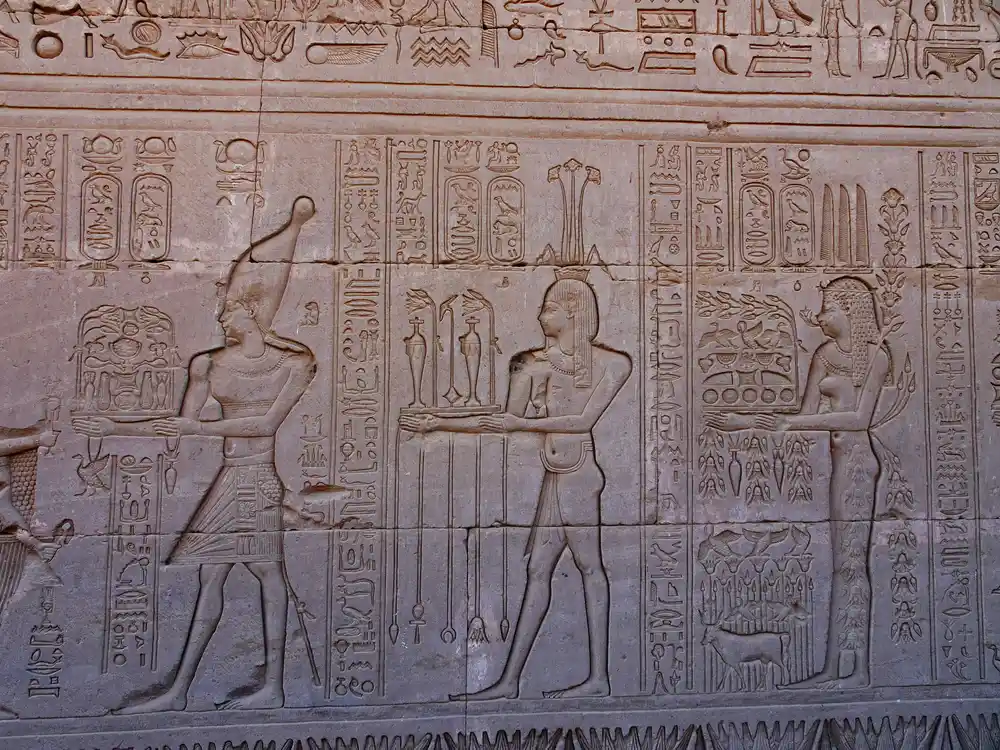
QV55 belongs to Amunherkhepshef, a son of Ramesses III who died as a boy. The reliefs show his father leading him by the hand and presenting him to the gods, and the king's hand on the child's is the detail everyone remembers. The colour is strong, the chamber is small, and the whole visit takes ten minutes.
QV44 is the tomb of Khaemwaset, another son of the same king, and it follows the same pattern of the father making the introductions. The painting is arguably crisper here. Fewer people stop.
QV52 belonged to Queen Tyti, whose husband is not securely identified, which is a small mystery given how much else we know about the period. The tomb is larger than the two princes' tombs and the decoration is more worn.
Together these three take about forty minutes at an unhurried pace. None of them is deep and none involves more than a short flight of steps, which makes this the easiest of the Theban tomb sites for anyone who found the royal valley hard going.
The princes' tombs reward a particular kind of attention. These were children, and the decoration was commissioned by a father who outlived them, so the scenes are not the standard royal programme. They are a king doing the introductions personally, over and over, in room after room.
The Other Eighty Six Tombs
Most of the valley is closed, and most of what is closed is not spectacular. Shaft burials, unfinished chambers, tombs reused in the Third Intermediate Period and again by Coptic monks, and a great deal that was emptied long before anyone recorded what was in it.
The Italian mission that found Nefertari in 1904 worked through dozens of these. Their notebooks are the reason we know the site was in use for four hundred years rather than one dynasty, and the reason the numbering runs as high as it does.
You will walk past the closed doors on your way between the open tombs. It is worth registering how many there are, because the number is the argument: this was not a handful of special burials, it was an industrial cemetery run by the state for the families of kings.
The men who cut and painted all of it lived in a village on the other side of the hill, a twenty minute walk away, and went home every night.
Where It Sits, and What the Site Plan Shows
The site is at the end of a short spur road that turns off the main west bank route just past Medinet Habu. Coming from the ferry it is the furthest of the main sites from the river, which is why it gets skipped.
Any valley of the queens map you are handed at the gate will show the tomb numbers scattered across a rough Y shape: a main wadi running roughly north to south with two shorter arms. Nefertari is low down and close to the entrance, on the left as you walk in. The princes' tombs sit further up the main arm. The numbered tombs that are not open are still visible as closed metal doors set into the rock, and there are a lot of them.
Distances are short. From the gate to the furthest open tomb is a few hundred metres of level gravel.
How This Fits a West Bank Morning
Badly, if you try to bolt it onto a full day that already has three sites in it. Well, if you plan the west bank across two mornings rather than one.
The standard single west bank morning is the royal tombs, Hatshepsut, the Colossi of Memnon, and out by lunch. Adding the valley of the queens luxor keeps at its southern end to that sequence means arriving here at the hottest part of the day with your attention already spent, which is the worst possible way to look at painted plaster.
The better shape is this one. First morning: the royal tombs at opening, then Hatshepsut. Second morning: this valley first, Medinet Habu second, both of them quiet, both of them in shade or indoors before ten.
The guide to choosing royal tombs covers the other half of that plan, and the wider Luxor area guide sets out how the two banks divide up across a stay. Our longer Egypt itineraries build the west bank as two mornings for exactly this reason.
Heat, Light and the Hour to Arrive
The valley is a bowl. It has almost no shade, it faces the sun for most of the day, and it holds heat the way a stone oven does. From April to October the difference between eight in the morning and eleven is the difference between comfortable and miserable.
Be at the gate when it opens. That is the single most useful sentence in this article.
Inside the tombs the light is artificial and dim, deliberately so, because light damages pigment. Your eyes need a minute to adjust each time you go down a stair, so do not walk straight in and start photographing. Stand still, let the chamber come up, then look.
Late afternoon is the second best option and a distant second. The tombs close earlier than you would expect and the last entry is earlier still.
Tickets, in the Order You Need Them
Two purchases, not one. The general valley ticket covers the three tombs on rotation. The Nefertari ticket is separate, costs several times as much, and is the one to sort out first because daily numbers are capped.
Where each is sold has changed over the years, and the west bank has both a central ticket office on the road in and desks at individual sites. Ask your driver or guide to confirm the current arrangement the day before rather than the morning of. Payment across the west bank is by card, with no cash desk, which surprises people every season.
Prices here, and for Nefertari in particular, are revised most years. Anything written down more than a few months ago will be wrong, so check the current rate close to your travel date.
A search for valley of the queens egypt will return Nefertari and very little else, and that is a fair reflection of how the site is sold rather than of what is in it. The princes are worth your forty minutes.
What to Look at First in QV66
You have ten minutes and your instinct will be to photograph everything. Do not.
Go down the stair, turn, and look at the queen's face in the first scene on your left, where Isis takes her hand. Then look up at the ceiling.
Then find the panel of Nefertari playing senet, the board game, alone. It is the most human image in any royal tomb in Egypt, and it is easy to walk past.
Those three things, properly looked at, are worth more than forty photographs of walls you will not be able to identify afterwards. Photograph whatever is left of your time.
On the way out, stop at the top of the stair and turn round. From there the whole painted corridor is in front of you at once, and it is the only view that gives you the scale of what one woman's burial chamber was worth to a king who outlived her by half a century.