Start with the thing that confuses everyone. The hatshepsut temple and the monument sold on itineraries as Deir el Bahari are not two places. They are one building with two names: an Arabic name taken from a Coptic monastery that later stood on the site, and an Egyptological one taken from the queen who built it.
If a schedule lists both, it has double counted a single morning.
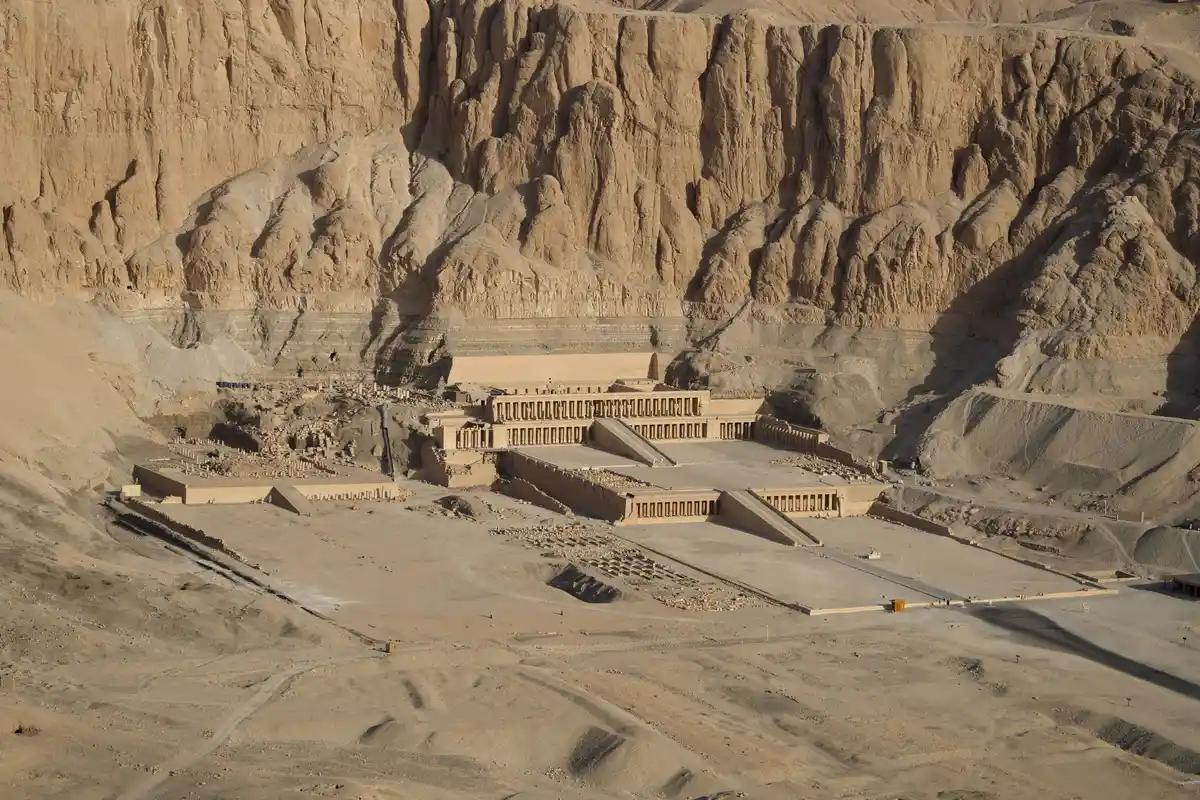
The ancient name was Djeser Djeseru, the holy of holies. It stands in a natural bay in the cliffs on the Theban west bank, three terraces rising on ramps against three hundred metres of rock, and it is the most immediately photogenic building in Egypt. It is also, on a summer morning, one of the hottest places you will ever stand.
Who Hatshepsut Was and Why the Building Exists
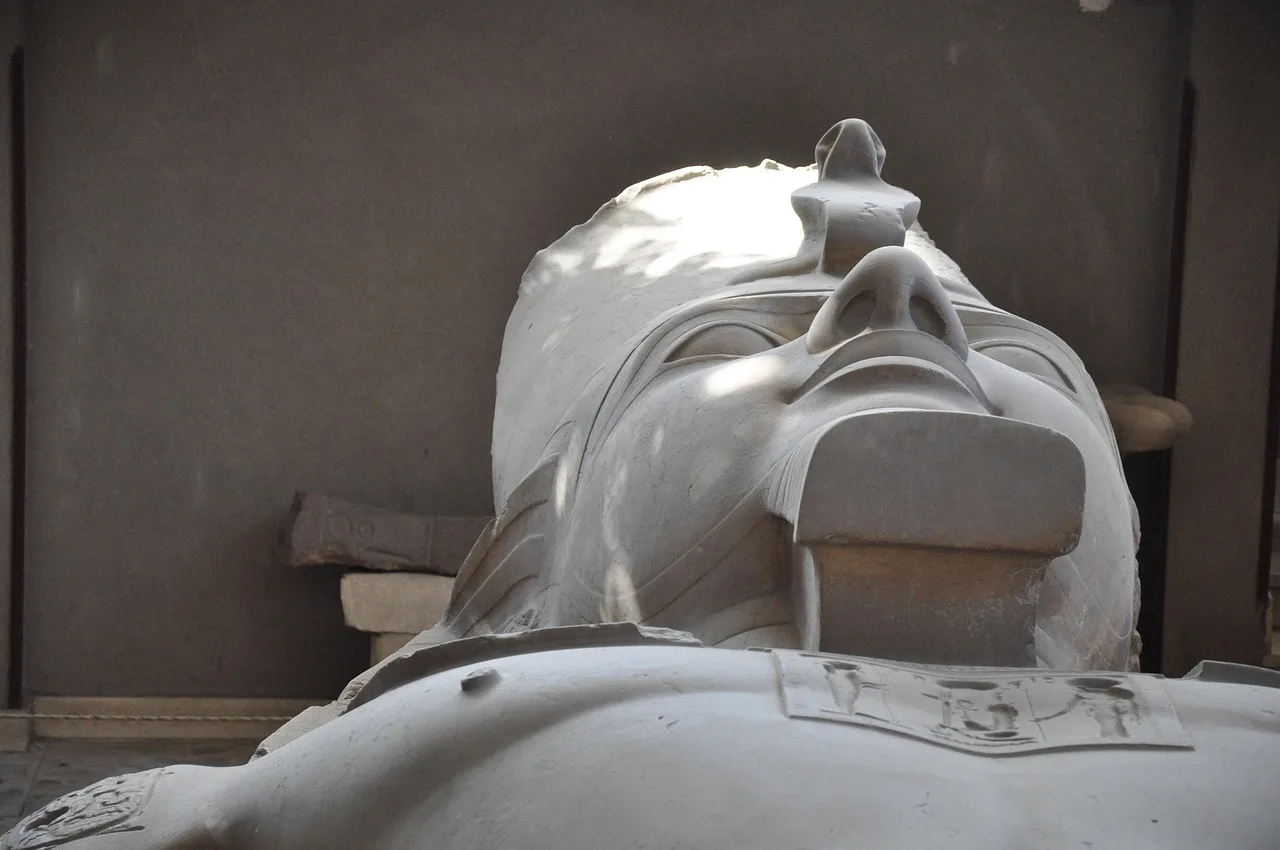
She was the daughter of Thutmose I and the wife of her half brother Thutmose II. When he died she became regent for his young son. Within a few years she had stopped being a regent and was ruling as king, with the full titulary, the crowns and, in most of her statuary, the false beard.
She held that position for around twenty two years. The reign was prosperous and almost entirely peaceful, which in the Eighteenth Dynasty made it unusual.
The building is a mortuary temple, meaning a place where her cult was maintained after death, not the place she was buried. Her tomb is in the royal valley on the other side of the same hill, roughly a kilometre away through the rock.
Her architect was Senenmut, a commoner who rose extraordinarily high, held around eighty titles and was tutor to her daughter. He built himself a tomb underneath the temple forecourt, which is not the act of a man worried about his position.
The Architecture, and Why It Looks Modern
Because it is doing something almost no other Egyptian temple does: answering the landscape rather than ignoring it.
Most temples are enclosed boxes, dark at the far end, with pylons announcing them from the front. This one is open, terraced and horizontal, with long colonnades of square piers that repeat the vertical fissures in the cliff behind. From a distance the building and the rock read as one shape.
There was a model. Five hundred years earlier Mentuhotep II built a terraced temple immediately to the south, and its ruins are still there beside the newer building, largely ignored by everyone walking past. Hatshepsut's architect took that idea and stretched it.
Three levels, two ramps on a single axis, colonnades to either side of each ramp. A causeway once ran from the edge of the cultivation to the lower court, lined with sphinxes.
The proportions are the reason it survives so well in photographs. Nothing on the facade is ornate and nothing is trying to overwhelm you.
That restraint was a choice, and it was not the fashion. Her father and her stepson both built in the enclosed, pylon fronted style, piling courts in front of courts. This building goes the other way and lets the cliff do the work of a pylon.
It has been called modernist more than once, usually by people who have just come from somewhere heavier. The comparison does not really hold, because every line here is doing religious work rather than aesthetic work, but it explains why the building photographs the way it does on a phone in 2026.
The Punt Reliefs on the Middle Terrace
South colonnade, middle level. This is the single best reason to come.
Around the fifteenth century BC Hatshepsut sent a trading expedition to the land of Punt, most likely somewhere on the coast of the Horn of Africa or southern Red Sea, and then had the whole voyage carved on a wall in sequence like a documentary.
The ships are shown being loaded. The houses of Punt are on stilts, reached by ladders, with palms around them. The ruler of Punt appears with his wife, Queen Ati, whose body is rendered with a frankness that has caused a century and a half of argument among people who would rather Egyptian art idealised everyone.
The cargo is itemised: incense, ebony, ivory, gold, apes, and thirty one living myrrh trees with their root balls wrapped, carried aboard on poles. Those trees were planted in the terrace gardens here, and the pits that held them have been found in front of the lower colonnade.
Very little else in Egyptian art records an actual journey this carefully. Most royal walls record battles that may or may not have happened.
The Divine Birth Colonnade
North side of the same terrace, and a colder kind of interesting.
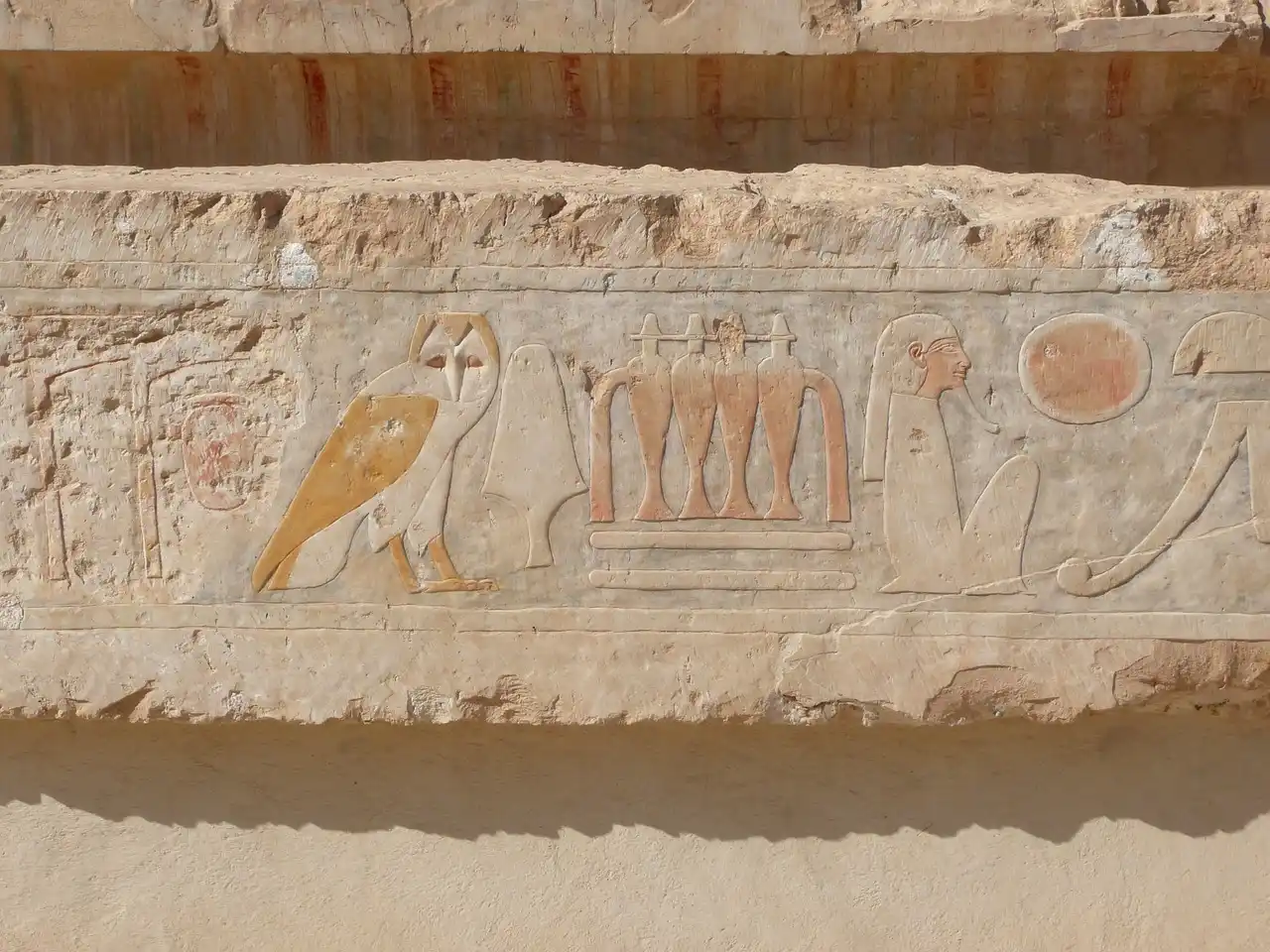
The reliefs show the god Amun visiting Hatshepsut's mother Ahmose in the form of her husband, and the conception, birth and divine acknowledgement of Hatshepsut herself. The child is presented to the gods and confirmed as the rightful ruler.
This is propaganda in the strict sense, carved in stone at public scale, arguing a case. A woman ruling as king had no precedent worth relying on, so the case had to be made theologically: not merely the daughter of a king, but the daughter of a god.
The panels are shallow and the light is poor for much of the day. Go in the first hour, when the sun is low enough to rake across them.
The Two Chapels Most Visitors Skip
At the south end of the middle terrace is the chapel of Hathor, with columns carved as the goddess's head, cow eared, in a form you will not see much elsewhere on the west bank. Inside are scenes of Hathor as a cow licking the king's hand.
At the north end is the chapel of Anubis, which has kept its ceiling and therefore its colour. Blue and yellow stars overhead, the jackal god receiving offerings, and a room dark enough that your eyes need a moment.
Both take five minutes. Both are missed by the majority of groups, who go up the ramps, photograph the top terrace and come down.
The upper terrace itself is worth slowing down for. Behind the colonnade of osiride pillars is a court, and behind that a sanctuary cut back into the living rock, which is the oldest architectural idea in the building and the one the whole design is arranged to arrive at.
Access to the sanctuary and to parts of the upper level opens and closes with restoration work. Ask at the gate which sections are open that day rather than finding out at the top of two ramps in full sun.
Hatshepsut Temple Facts That Change How You Look at It
The erasure is the one nobody expects. Late in the reign of Thutmose III, some twenty years after her death, her name and image were systematically chiselled out of this building and her statues were smashed and dumped in a pit in front of it.
You can see the damage as you walk. Blank ovals where cartouches were, figures cut back to flat stone, and in places a replacement figure of Thutmose I or II carved over the top.
Why it happened is still argued. The old story of a resentful stepson waiting to take revenge does not fit the twenty year delay. The likelier explanation is dynastic: removing a female king from the record to make the succession run cleanly from father to son to grandson.
The second fact is how much of what you see is restoration. A Polish and Egyptian mission has worked here since 1961, and the upper terrace colonnade in particular has been substantially reassembled from fallen blocks. The work is documented and the joins are visible if you look for them.
The third is the statues. Those smashed pieces were excavated in the 1920s and painstakingly rebuilt, and the large kneeling and standing figures of Hatshepsut now in museums came out of that pit.
What the Queen Hatshepsut Temple Looked Like When New
Green, for a start.
The lower terrace had gardens with trees, including the myrrh brought from Punt, and T shaped pools. The ramps and courts were lined with painted sphinxes and standing osiride statues of the king. The white limestone was not bare: the colonnades were painted, and traces survive in the protected corners of the upper level.
Try to see it that way as you walk up. Colour, trees, water, and a processional route running down to the river.
The temple was connected to the east bank by that route once a year, in the Beautiful Festival of the Valley, when the god's image crossed the Nile and the population came over to picnic and drink at the family tombs in the hills. The building was not a quiet museum piece. It was the end point of a party.
How Long, and When to Arrive
Ninety minutes is enough for the terraces, both chapels and the Punt wall at a proper pace. Two hours if you also walk over to the Mentuhotep ruins.
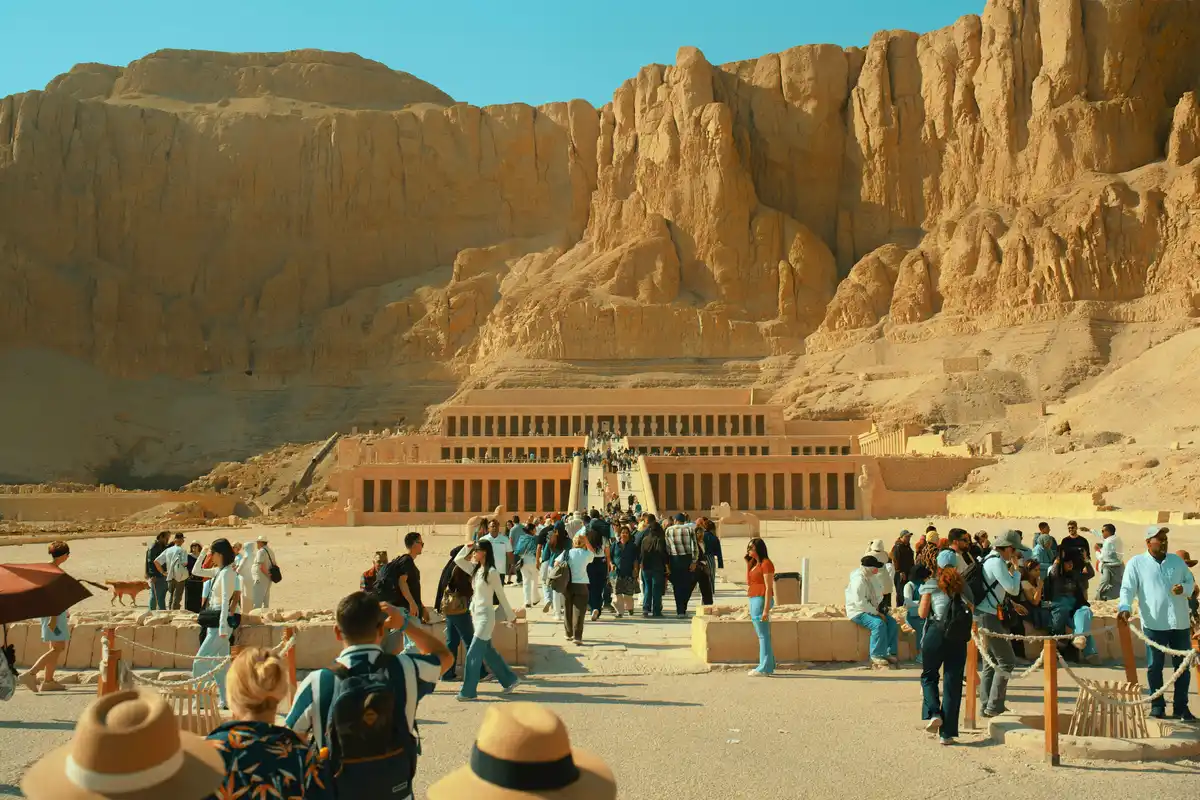
Almost nobody gets ninety minutes. The standard west bank morning allows about forty here, which covers the walk up, a photograph from the middle ramp and a look at whichever colonnade the guide prefers. That is the difference between seeing the temple of hatshepsut and seeing a photograph of it with your own eyes.
Arrive at opening. This is not a general recommendation, it is specific to this building: the bay faces east, the cliff behind it reflects heat back at you, and there is no shade anywhere on the terraces except inside the two chapels. By ten in the morning in spring the stone is uncomfortable to touch.
There is a shuttle from the car park to the foot of the causeway, a few hundred metres, and it is worth taking on the way out rather than the way in.
The mortuary temple of hatshepsut is usually done second on a west bank morning, after the royal tombs, and that order is correct. The tombs are underground and unbearable late. This is above ground and unbearable late. The tombs win the early slot because they cannot be done any other way.
Where It Sits in a Luxor Plan
The guide to choosing royal tombs covers the first half of that morning, including which three tombs to buy and why. Hatshepsut's own tomb, KV20, is not normally on the visitor circuit.
For how the west bank divides against the east across a longer stay, the Luxor area guide is the place to start. Our longer Egypt itineraries give the west bank two mornings, which is what lets this building have ninety minutes rather than forty.
The temple of hatshepsut egypt has restored and re restored over sixty years is not a quick photo stop, though it is very often treated as one. The terraces take ten minutes. The walls take the other eighty.
What to Look at, in Order
Walk straight up both ramps to the top terrace first, before the coaches. Look back down the axis from the upper court, because that view along the causeway towards the cultivation is the one the architecture was designed around.
Then come down one level and turn south to the Punt colonnade. Give it twenty minutes. Find the ships, then the stilted houses, then Queen Ati, then the trees being carried.
Then cross to the birth colonnade on the north side of the same terrace.
Then the Hathor chapel, then Anubis for the ceiling and the shade.
On your way out, stop at the deir el bahari temple of Mentuhotep II to the south, which is a ruin of low walls and a few column bases and takes four minutes. It is the building Hatshepsut's architect was answering, and standing in it is the only way to see that this masterpiece was a remix.
One last instruction. Before you leave the upper terrace, find a cartouche that has been chiselled out, put your hand flat against the blank, and note that somebody stood exactly there with a chisel and orders. That is the part of this building people remember longest.