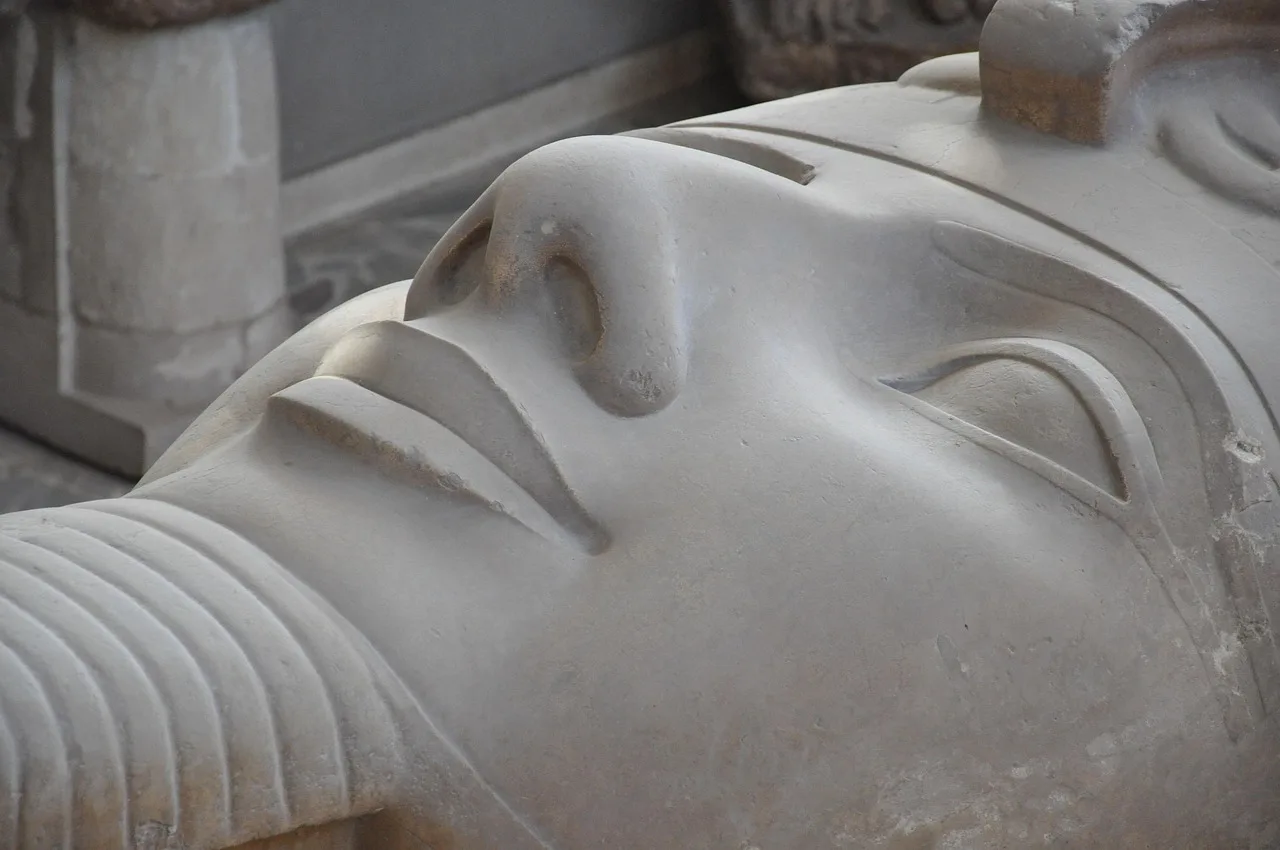
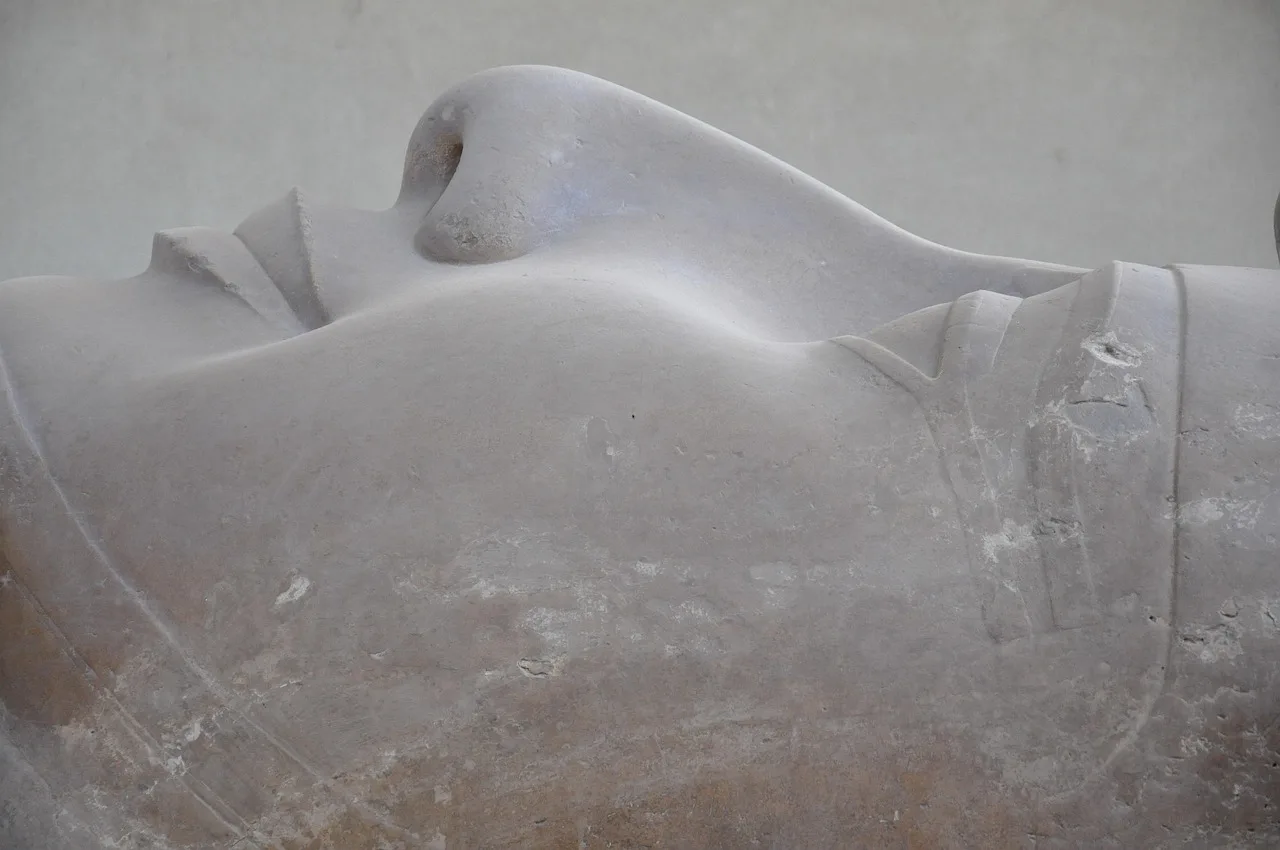
He is lying on his back, ten metres of him, looking at the ceiling.
The open air museum memphis egypt keeps at the village of Mit Rahina is built around one object, and that object is a fallen statue of Ramesses II that nobody has ever managed to stand up again. You walk in at ground level, then up onto a gallery, and you end up looking down at a king's face from about the height of his shoulder. There is no other view like it in the country.
The whole visit takes forty minutes. Plan accordingly, because the value here is not in the time it takes.
The Open Air Museum Memphis Egypt Built Around a Fallen King
The colossus was found in 1820 by Giovanni Caviglia, face down in mud near the site of the great temple of Ptah. It is limestone, it was carved in the thirteenth century BC, and it is missing its lower legs, which is why it has never been re erected.
For a long time it lay in the open under a simple shelter. It now has a purpose built hall with a raised walkway running along one side, so you can see the face from above and then go down and walk the length of the body.
Look at the workmanship close up. The fingernails are carved. The cartouches on the belt and the shoulder are crisp. Whatever you think of Ramesses II as a self publicist, and the case against him is strong, the sculptors who worked for him were the best in the world at the time.
A second colossus from the same site stood for decades in a traffic square in central Cairo, breathing exhaust fumes, until it was moved out to the new museum near the pyramids. This one stayed where it fell.
The Alabaster Sphinx
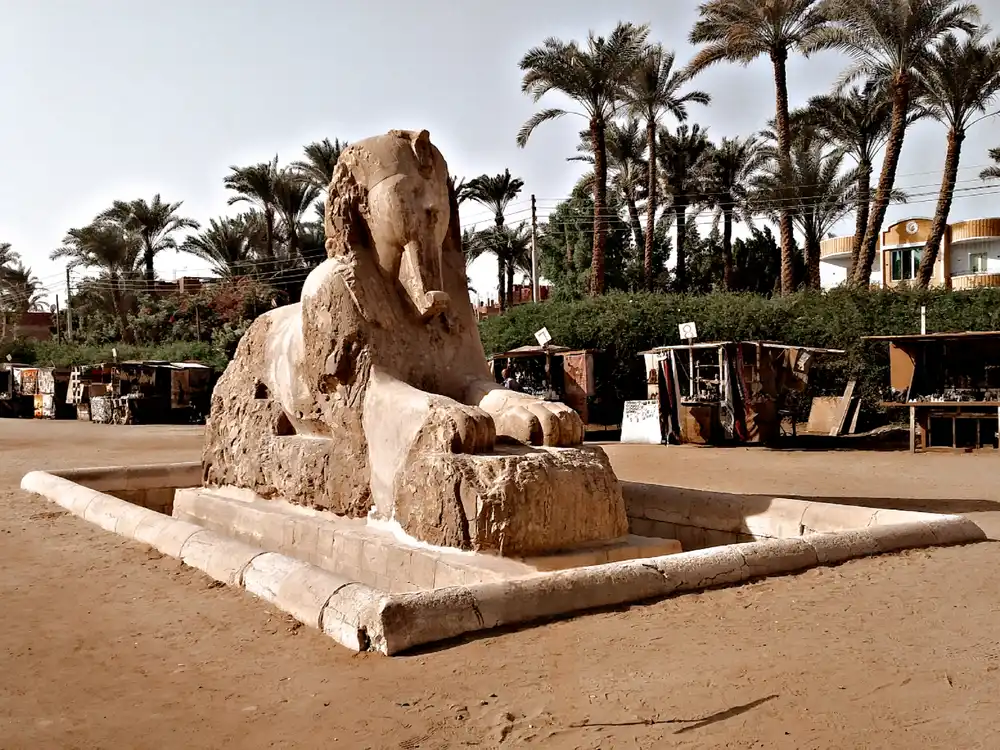
Outside in the garden, and easy to walk past because it sits low.
Roughly eight metres long and estimated at around eighty tonnes, carved from a single block of Egyptian alabaster, which is calcite rather than the softer gypsum alabaster of European sculpture. It has no inscription, so the attribution is argued: Hatshepsut, Amenhotep II and Thutmose III have all been proposed on stylistic grounds.
It is the largest alabaster statue known. The surface has weathered to a soft cream and in late afternoon light it goes almost translucent at the edges.
Walk round the back. The rear legs and tail are carved with the same care as the face, which is not something the original viewers would often have seen.
What Else Is Actually on Display
Less than you might expect, and that is worth knowing before you arrive.
The garden holds a scattering of statuary, mostly Ramesses II again, plus sarcophagi, temple column fragments, Hathor headed capitals and a run of sphinxes. Much of it is unlabelled or labelled minimally.
The one item people miss is the alabaster embalming table, a large slab carved with channels, used in the mummification of the Apis bulls that were the living form of Ptah and were buried in enormous stone sarcophagi at Saqqara. It is flat, it is in the open, and it explains the bull galleries up the road better than any sign at Saqqara does.
There is a small indoor room with minor objects. It takes five minutes.
What the open air museum memphis egypt has assembled here is a rescue collection rather than a curated one. These are the pieces that were too big to move, too broken to sell, or found after the era when finds left the country. That is not a criticism. It is the reason the two great objects are still standing in the fields they were carved for.
Why There Is So Little Left of Memphis
Because the city was built of mud brick, and because the stone that was not mud brick was carried away to build Cairo.
Memphis was the capital of Egypt for most of the Old Kingdom and stayed a major city for two thousand years after that. The temple of Ptah at its centre was called Hut ka Ptah, and the Greek rendering of that name is where the word Egypt ultimately comes from.
Ptah was the craftsman god, patron of sculptors and metalworkers, and the city was the country's workshop as much as its capital. That is a useful thing to hold in mind while looking at the fingernails on the colossus.
The Apis bull lived in the temple precinct here as the god made flesh. One bull at a time, selected by its markings, kept, fed, consulted as an oracle, and on its death embalmed on a table like the one in the garden and carried up to Saqqara for burial.
What is above ground today is a village, palm groves, farmland and a few enclosures of excavated rubble. The water table has risen since antiquity and much of the ancient city sits below it, waterlogged and unexcavated.
So the memphis open air museum is not a ruin you walk around. It is a collection of what survived, gathered into a garden beside the village, with the city itself under the fields behind it.
Fitting It Into a Saqqara Morning
This is the part that matters. On its own the site is a curiosity. In sequence it is the thing that makes the whole day legible.
Mit Rahina sits about three kilometres from Saqqara and roughly twenty five south of central Cairo. Saqqara is the necropolis of Memphis: the stepped royal tomb, the mastabas of officials, the bull galleries. The city those tombs belonged to is this one.
Visit the city first, then the cemetery. Forty minutes here, then two or three hours at Saqqara, and the tombs stop being isolated monuments in sand.
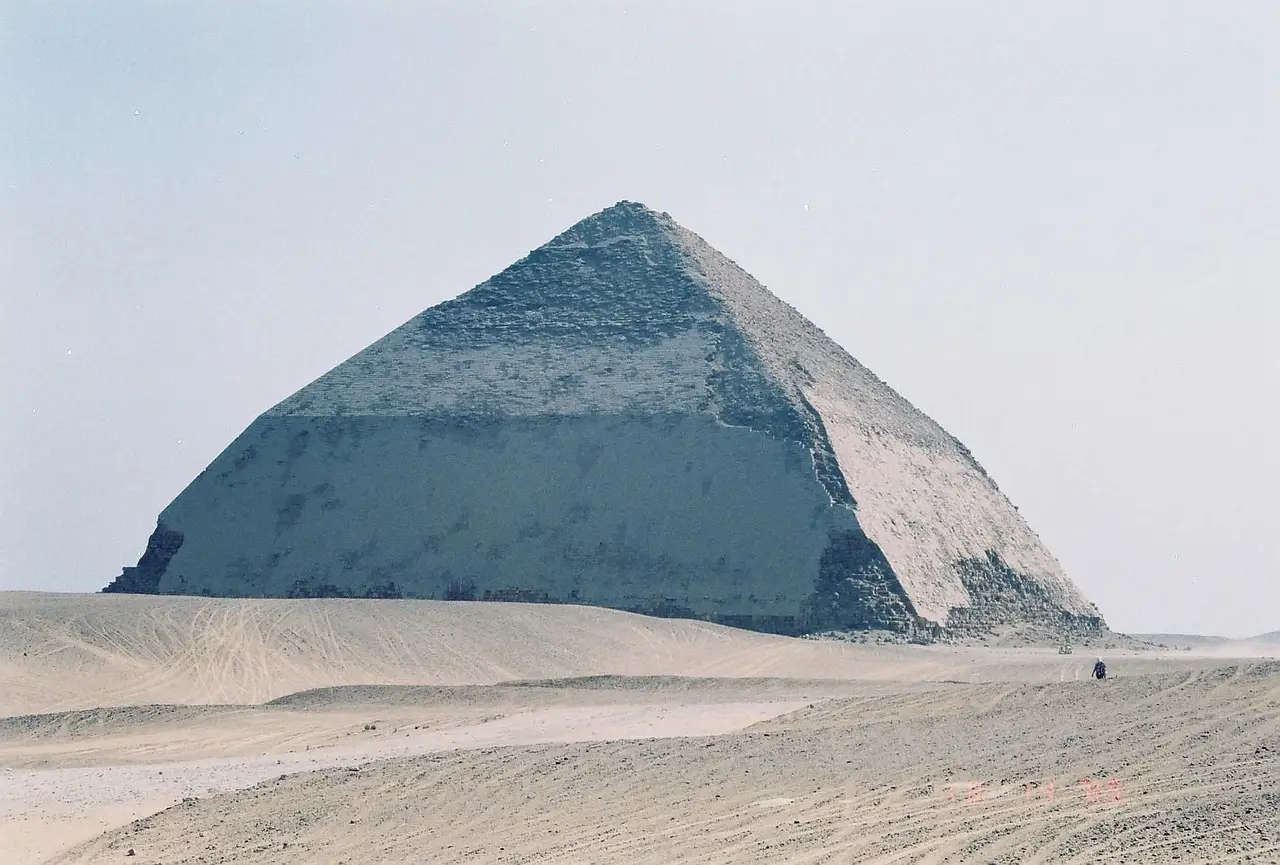
Dahshur is ten kilometres further south and adds the two pyramids of Sneferu, which are the best argument in Egypt for how pyramid building was worked out by trial and error. The guide to Dahshur covers that pair in detail and why the Bent Pyramid is the more interesting of the two.
All three in one day is a long morning and an early start. It is also the single best day trip out of the capital, and the Cairo area guide sets out how it compares with the Giza plateau. Our longer Egypt itineraries run this trio as one full day rather than splitting it.
Practical Detail
Tickets are bought at the gate and are inexpensive compared with the major sites. Payment across the Cairo area has largely moved to card, so do not rely on cash.
There is a car park, a row of souvenir stalls and a toilet block. The stalls are persistent and there is no way round them to the entrance.
Shade is limited in the garden. The colossus hall is covered and cool, everything else is open, and between May and September the middle of the day is unpleasant.
Guides are not supplied at the gate and the labelling will not do the job for you. If you are travelling with an Egyptologist they will spend most of the stop on the colossus and the embalming table, which is the right allocation. If you are not, read about Ptah and the Apis bull before you arrive, because those two things are what the site is about and neither is explained on any sign in the garden.
The site is flat and the walkway in the colossus hall has a ramp as well as steps, which makes this one of the more accessible ancient sites near Cairo. Saqqara, half an hour later, is the opposite.
When to Go and What to Photograph
Early, for the same reason as everywhere else in Egypt, but here there is a second argument for late.
The colossus is indoors under a roof, so its light does not change much through the day. The sphinx is outdoors and it does. Around four in the afternoon the low sun comes across the alabaster from the side and picks out the tool marks, and that is the photograph.
If you are doing memphis open air museum egypt style sightseeing as part of a Saqqara day, you will be here in the morning and the sphinx will be flatly lit. That is the trade, and it is the right one.
One instruction for the colossus hall: go up to the gallery first, walk the full length of it, and only then go down to floor level. In the other order the face from above loses most of its effect, because you have already seen the whole statue and your eye has stopped being surprised by the scale.
See our private Egypt day tours for a guided day around Memphis and Saqqara.