The ceiling at Dendera is blue.
Not faded blue, not blue if you squint. Blue the way it was painted about two thousand years ago, with gold stars on it, cleaned of nineteen centuries of soot in a restoration that ran through the 2000s and 2010s and that almost nobody outside Egypt has heard about. The dendera temple egypt day trip exists because of that ceiling, and it stays worth doing because of what else is under it.
The trip is usually sold as a pair with Abydos, ninety minutes further on. That pairing is the right call for some people and the wrong one for others, and it is worth being honest about which you are before you spend a day on the road.
Where These Two Places Are
Dendera sits near Qena, about 60 kilometres north of Luxor. The drive takes an hour to an hour and a half depending on the traffic through the towns.
Abydos is further, near El Balyana, roughly 150 kilometres from Luxor and two and a half hours each way. They are not next to each other in any useful sense. You are driving north, stopping, driving further north, stopping, then driving all the way back.
The old convoy system, where foreign vehicles travelled in police escorted groups at fixed hours, is gone. You leave when you want to.
That matters more than it sounds. Under the convoys you arrived at both temples at the same hour as everyone else, in the heat, in a crowd of forty vehicles. Now a car leaving Luxor at six can have the Dendera hypostyle hall to itself for twenty minutes.
The Ceiling at Dendera Temple Egypt Is the Reason to Come
The hypostyle hall has twenty four columns with Hathor heads on all four faces, and above them a ceiling divided into seven bands of astronomical scenes: the sky goddess Nut swallowing the sun and giving birth to it, the decans, the planets drawn as travelling gods.
For most of the modern era this was black. Generations of people sheltering and cooking inside the hall left a layer of soot that photographs from the 1980s show as an even dark grey. The cleaning ran in phases over more than a decade and the effect on arrival is genuinely startling, because nothing prepares you for colour at that saturation on a two thousand year old ceiling.
Look up before you look at anything else. Everyone does it in the wrong order and spends the first ten minutes photographing columns.
The hall is also darker than photographs suggest. Your eyes need a minute, and the guardians carry torches and will light a band of the ceiling for you if you ask, which turns a flat blue expanse into figures and boats and stars.
What Else Is Inside
The Temple of Hathor at Dendera is unusually complete, and completeness is what makes it readable. There is a roof you can climb to, with chapels where the new year ritual took place and a good view over the mudbrick enclosure wall.
There are crypts under the floor, narrow and low, carrying relief so crisp it looks recut. One is usually open and it involves a bent walk of about fifteen metres.
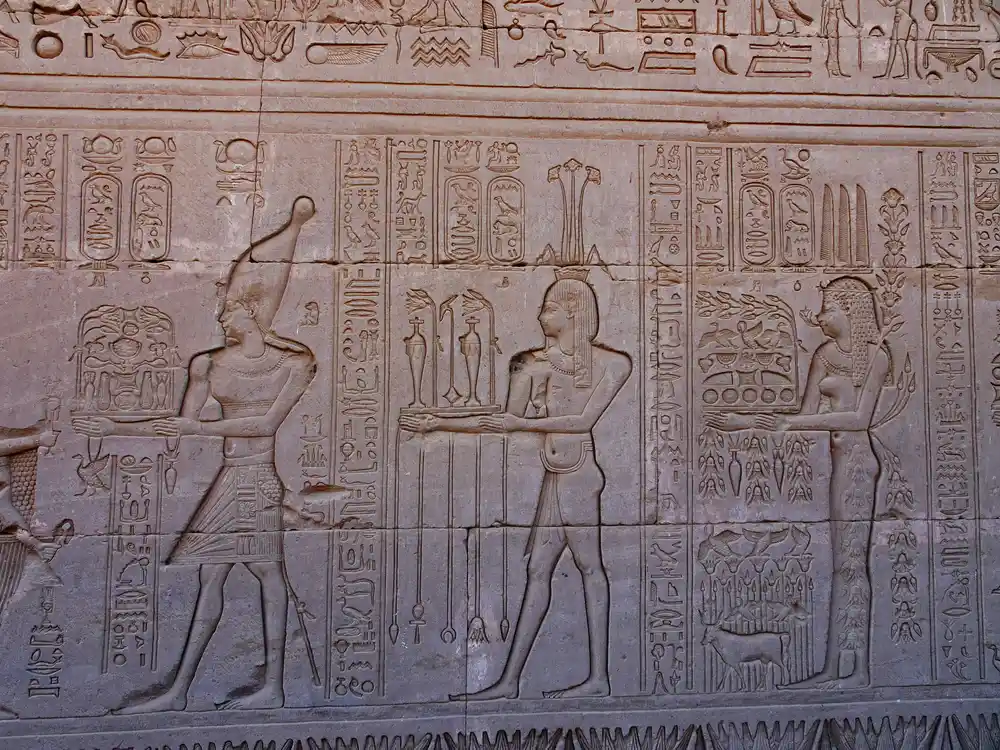
On the rear exterior wall is a well known relief of Cleopatra VII with her son Caesarion, making offerings. It is one of the few images of her carved in Egypt during her lifetime, and it is nothing like the face on the coins.
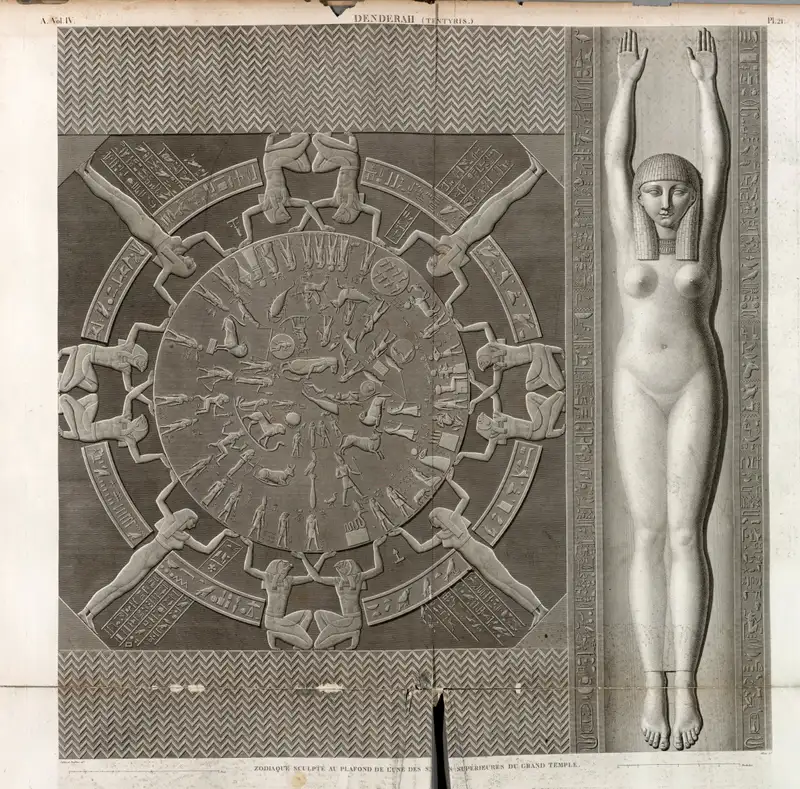
The zodiac everyone asks about is a circular sky map from a roof chapel. The original was cut out of the ceiling in 1821 and is in the Louvre. What is in place is a cast, and nobody at the site pretends otherwise.
Abydos: A Different Kind of Building
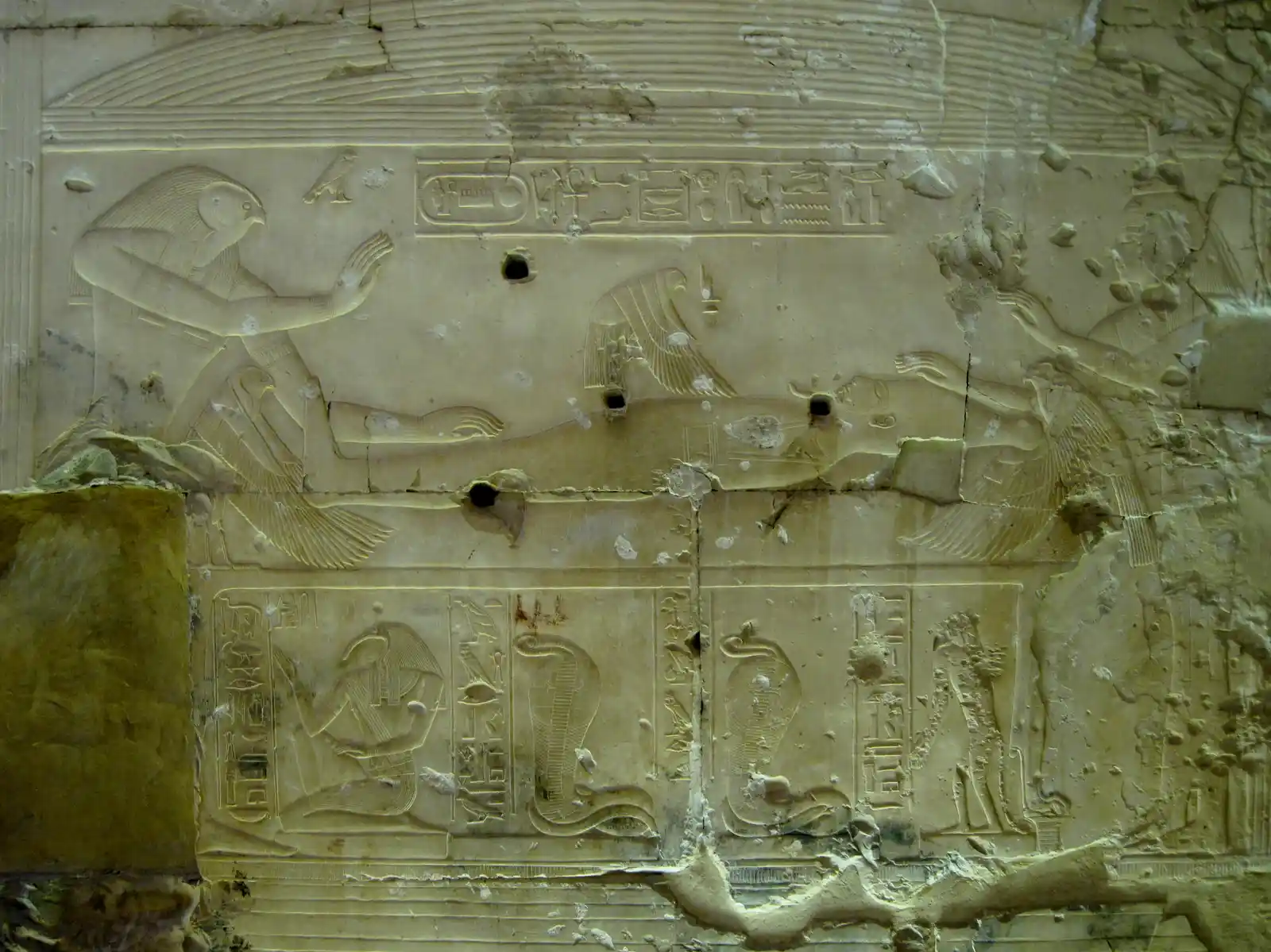
The abydos temple most people mean is the Temple of Seti I, and it is a strange, sober, beautiful thing after the exuberance of Dendera.
Seti built it in the early Nineteenth Dynasty as a cult centre for Osiris, whose most important shrine stood here. It has seven sanctuaries side by side rather than the usual one, an L shaped plan that survives from a change of design, and relief carving that Egyptologists have been using as the benchmark for the period since the first surveys.
The relief carving in the Temple of Seti I Abydos is the best preserved of its period anywhere in Egypt. Raised relief, cut shallow, with the modelling of a shoulder or a hand still legible under a torch. Ramesses II finished parts of the building after his father died and the drop in quality between the two is visible in a single corridor, which is an education in itself.
The King List, and Why Historians Care
In a corridor off the main temple is a wall carrying 76 cartouches: Seti and his son standing before the names of the kings who came before them, in order, back to the first dynasty.
It is one of the main sources for the sequence of Egyptian rulers, and it is also an edited one. Hatshepsut is missing. Akhenaten, Smenkhkare, Tutankhamun and Ay are all missing. The list runs from Ramesses I straight back past the Amarna period as though it never happened.
Standing in front of an official document that quietly deletes four reigns is more interesting than most things carved on a wall, and it takes thirty seconds to explain to anyone travelling with you.
The Osireion
Behind the temple, down a slope and usually holding water, is a structure of enormous rough granite blocks on a completely different scale from everything around it.
The Osireion was built as a symbolic tomb of Osiris, its central platform surrounded by groundwater so that it reads as an island rising from the primeval waters. The water table has risen since, so it is often flooded and you look at it from above rather than walking in.
It is usually the part visitors remember, partly because it looks nothing like a temple and partly because the masonry is so unlike anything else at the site that people assume it is far older. There is no good evidence for that, and it does not need to be older to be remarkable.
The Marks on the Architrave
Somewhere on your visit a guide will point out a block carrying shapes that look like a helicopter and an aircraft. It is worth knowing what you are looking at before someone tells you it is proof of something.
It is a palimpsest. Seti's original inscription was plastered over and recut with Ramesses II's titles, the plaster fell away over the centuries, and two sets of overlapping signs now read as one image. Both original texts are known and both are ordinary royal titles.
This is not a fringe reading of the evidence. It is what the two inscriptions say when they are read separately, which they have been, repeatedly, since the 1990s.
Should You Do This Trip at All
Here is the part most articles leave out. If you have one day in Luxor, do not do this. You would be trading Karnak, the Valley of the Kings and Hatshepsut for ten hours in a car and two temples that will mean much less without the context those sites give you.
Three full days in Luxor is the point where this becomes a good idea. By then you have seen enough New Kingdom temple architecture that Dendera's Ptolemaic exuberance and Seti's restraint both land as deliberate choices rather than as more of the same.
If you have two days and you want one of the two, take Dendera. It is a third of the driving and the ceiling is the single most surprising thing on this stretch of the Nile.
How the Day Actually Runs
Leave Luxor at 6 or 7. Doing Abydos first and Dendera on the way back is the order most drivers prefer, because it puts the long leg at the start while everyone is fresh and gets you to Dendera in better light.
Allow an hour and a half at Abydos and two hours at Dendera. Both are open early, and in summer the first hour of the day at each is worth more than the next three.
Budget ten to twelve hours door to door. Take food. There is very little at either site and the road between them runs through towns rather than anywhere set up to feed visitors.
One more thing about the order. If you are doing the dendera temple egypt trip in summer, reverse it and take Dendera first at opening, because the hypostyle hall is the one interior on the route that stays cool and you want it before the day builds rather than after.
Going Without a Driver
It is possible and it is not comfortable. There are trains from Luxor to Qena, about an hour, and from Qena you would need a taxi for the last eight kilometres to Dendera temple and back. That works as a half day for one site.
Abydos by public transport is a different proposition. Trains to El Balyana run, the station is some way from the temple, and the return timings are the problem rather than the outward leg. People do it. Most who have done it once hire a car the second time.
A driver for the full day, shared between two or four people, usually costs less per head than two sets of train tickets plus four taxis, and it removes the part of the day where you are standing on a platform at four in the afternoon doing arithmetic.
If you are already on a Nile cruise, check your itinerary before booking anything. A few longer cruises include Dendera on the Luxor to Qena stretch, and paying twice for the same temple is a common and avoidable mistake.
Tickets, and What Nobody Can Tell You in Advance
Entry prices at both sites change most years and are card only, as they are across Upper Egypt now. Check the current rate before you go, or ask your operator to confirm it alongside your itinerary.
Photography inside both temples has been free for phones for several seasons, with a permit required for a tripod or a professional body. Ask at the window rather than assuming, because this is the rule that changes most often.
What to Read Before You Go
One page on Osiris will change the Abydos visit completely. The seven sanctuaries, the king list and the Osireion are all doing one job, which is tying a living king to a dead god, and the building stops being a set of rooms once that clicks.
For Dendera, read about the Ptolemaic period for five minutes. Knowing that Greek speaking rulers commissioned a thoroughly Egyptian temple, and that Roman emperors are carved on it making offerings as pharaohs, explains most of what looks odd about the place.
Both sites pair naturally with the west bank. The Luxor area guide covers how the banks split across a stay, and the guide to choosing tombs is the other decision worth making before you arrive rather than at a ticket window. For a longer trip that fits both in without a forced march, our twelve day itinerary spreads the area across several mornings.
Last practical note. Both temples face roughly north and their best interior light is mid morning, which is another argument for Abydos first: arrive there at nine, reach Dendera by one, and you will have caught each of them close to its hour.