A donkey fell through the ground here in 1996 and landed in a cemetery holding several hundred gilded mummies.
That is the story everyone tells about bahariya oasis egypt keeps in its Western Desert, and the frustrating thing is that it has become the only story. Most visitors arrive after four hours on the Cairo road, change vehicles, and drive straight out into the sand without stopping. The oasis is treated as a fuel station with palm trees.
It is a basin fifteen kilometres across with hot springs, a Twenty Sixth Dynasty necropolis, a temple carrying Alexander's name and a hill made largely of iron. Give it a night.
Where Bahariya Oasis Egypt Sits
About three hundred and sixty five kilometres southwest of Cairo, on good tarmac the whole way, which is four to five hours by road. The main town is Bawiti and the population of the whole depression is somewhere around thirty thousand.
It is the closest of the Western Desert oases to the capital, which is why it became the gateway to the White Desert rather than Farafra, which is actually nearer to the chalk.
Bahariya oasis sits in a depression roughly ninety kilometres long and fifteen wide, ringed by escarpments, with the cultivated ground concentrated in the north around Bawiti and a string of smaller villages beyond it. The floor of the basin is around a hundred metres below the plateau you drive in across.
The basin is lower than the surrounding plateau, which is why there is water at all. Groundwater from the Nubian Sandstone aquifer reaches the surface here through springs and boreholes, and the date palms, olives and apricots follow the water.
The Springs
Several, and they are not all the same thing.
The hot springs run genuinely hot, in places too hot to get into without waiting, and they come from deep boreholes. Bir Sigam, out on the Cairo road, is the best known of them. Sitting in one at night with the temperature near freezing outside is the strongest argument for staying over.
The cold springs are for swimming rather than soaking. Bir al Ghaba, in a palm grove northeast of town, is the one most often visited.
A practical note that matters more than it should: these are public or semi public places in a conservative rural community. Women swimming will want to be covered, and the hotels with their own spring fed pools exist partly to solve that problem.
The Valley of the Golden Mummies
Found in 1996, excavated from 1999, and genuinely one of the largest cemetery discoveries made in Egypt in the last century.
It is Greco Roman, not pharaonic, dating from roughly the first to the fourth century AD, when the oasis was wealthy from wine and dates. Estimates of how many burials the site holds run into the thousands and only a fraction has been excavated.
The name comes from the cartonnage masks: gilded faces over painted chest plates, some in a Roman portrait style and some in the older Egyptian idiom, often in the same tomb.
The excavated valley itself is not open for general visiting. A selection of the mummies is displayed in a small museum in Bawiti, which is a modest building with poor lighting and an extraordinary collection in it.
Stand in front of the masks for a while. The faces are individual in a way pharaonic work rarely is, because Roman period portraiture was trying to record a particular person rather than an eternal type, and several of them are unmistakably somebody.
The wealth behind the cemetery came from wine. This was a producing region supplying the Nile valley, and the amphora stamps found across bahariya oasis egypt sites are how that trade was traced.
What Else Is in Bawiti
Two Twenty Sixth Dynasty tombs are open, belonging to a merchant called Zed Amun ef ankh and his son Bannentiu. They are cut into rock under the modern town, reached by a stair, and the painted astronomical ceiling in the second is worth the climb down.
The temple of Ain el Muftella is a complex of small chapels on the edge of the cultivation, Twenty Sixth Dynasty again, heavily restored and covered by protective roofing.
There is also a small temple that carries the cartouche of Alexander the Great, which is unusual: it is the only known temple in Egypt where he appears in relief as pharaoh. It is ruined and it takes ten minutes.
Gebel al Ingleez, the English Mountain, has the remains of a stone lookout built by a British officer during the First World War to watch for Senussi raiders. The view over the whole depression from up there at sunset is the best in the oasis.
The Black Hills and the Dinosaurs
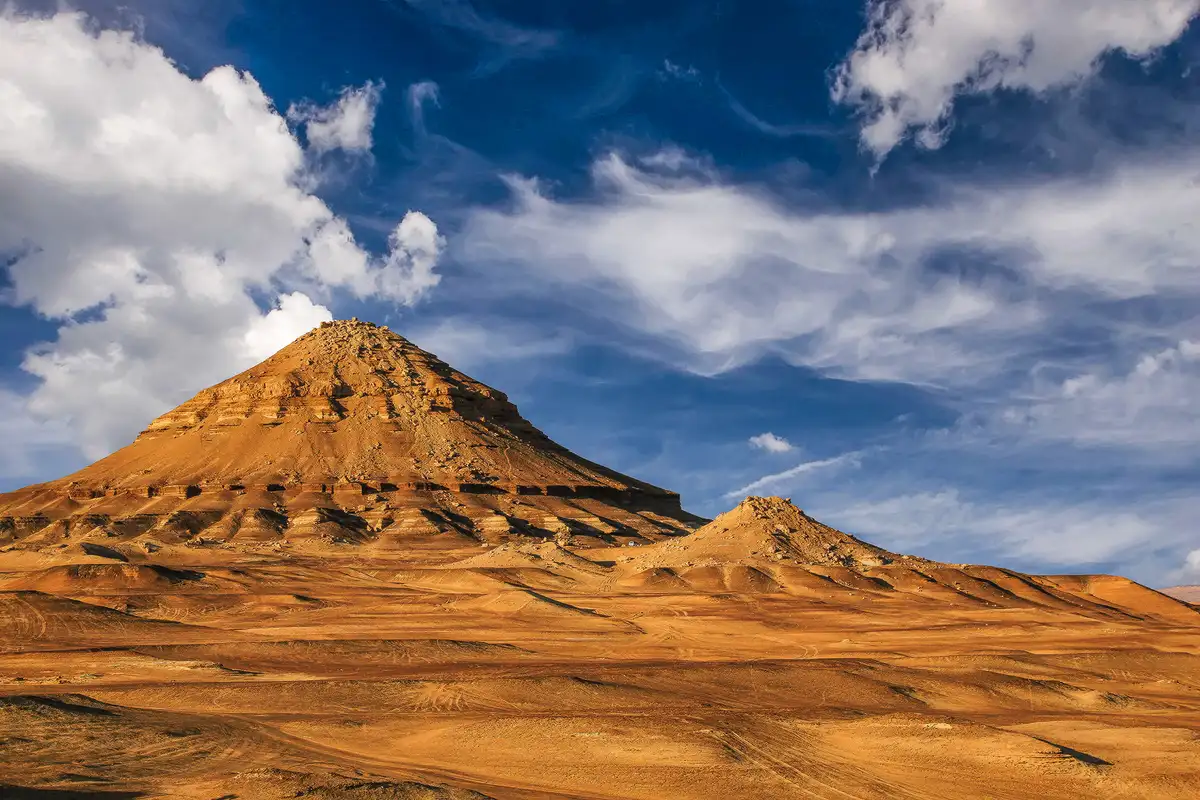
The dark conical hills that start south of town and run for thirty kilometres are the Black Desert, and they are capped with fragments of dolerite weathered out of the rock above.
Gebel Dist and Gebel Maghrafa stand apart from the rest, steep and almost pyramidal. Gebel Dist is where a Cretaceous dinosaur, Paralititan stromeri, was excavated in 2000 and 2001, one of the largest sauropods known. The beds here were mangrove swamp a hundred million years ago.
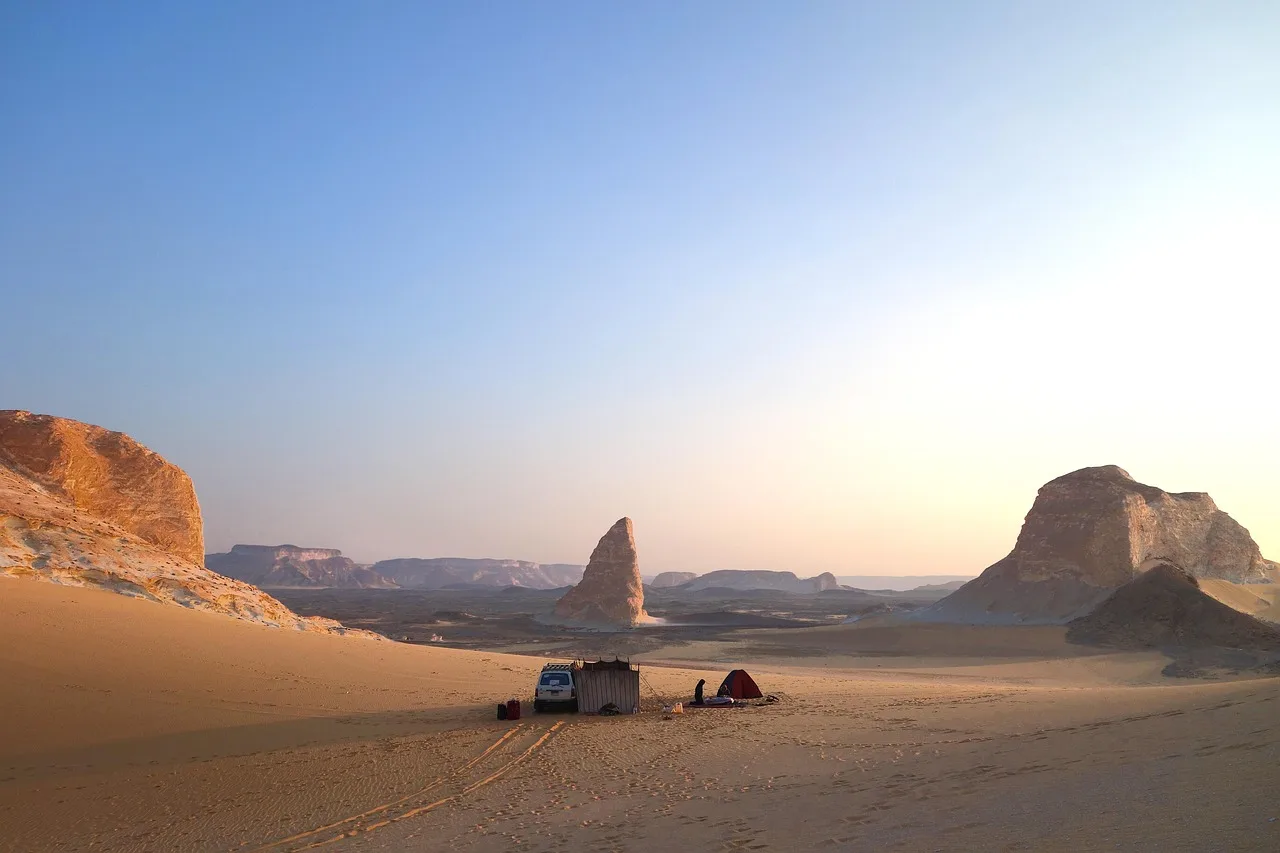
You will drive past all of this on the way to the chalk. The guide to the two deserts covers what happens after the hills, and why the pair is almost always visited together.
The oasis is where the sand trip is assembled, whichever way you do it. A luxury desert camp and a mattress on a rug behind a windbreak both leave from the same handful of yards in Bawiti.
Bahariya Oasis Hotels and Where to Sleep
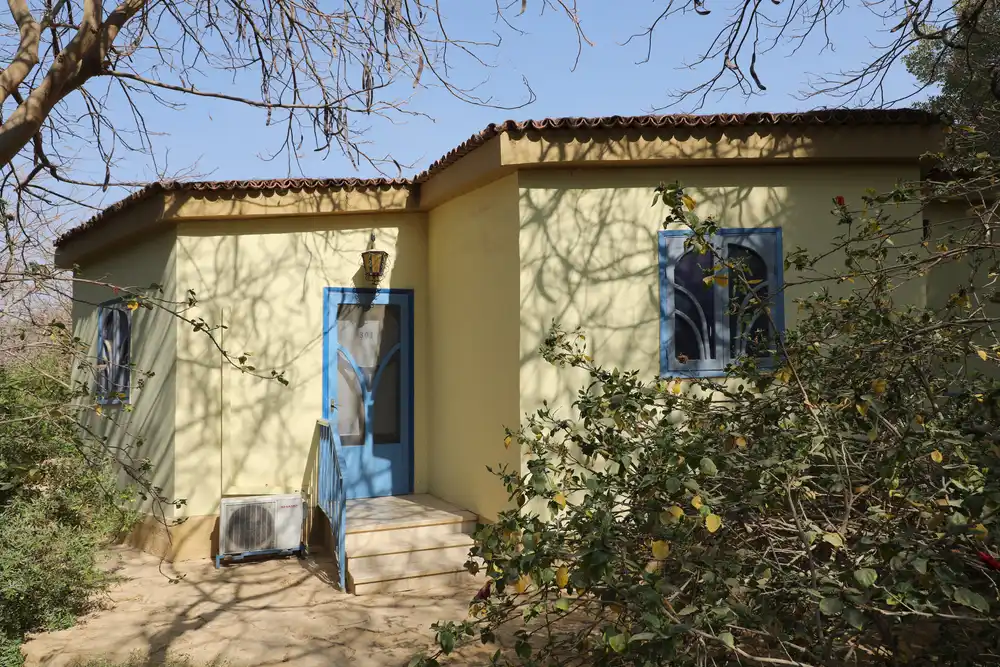
Expect simple. Bahariya oasis hotels are small, family run, often mud brick, and several sit out in the palm groves rather than in town. A few have their own spring fed pools, which is the feature to ask about.
There is no international chain here and there will not be one. The better places are comfortable, clean and quiet, with good home cooking and no bar.
Most desert operators include the oasis night as part of the package, either before or after the sand, and book it for you. A bahariya oasis tour sold from Cairo will normally put you in the same handful of properties.
If you are choosing yourself, the question to ask is how far from Bawiti you are and whether there is a spring on site. Those two things decide the evening.
Heating is the other thing to check in winter. Rooms in bahariya oasis egypt lodges are built for summer heat, with thick walls and small windows, and a December night can be genuinely cold indoors. Ask whether there are extra blankets rather than assuming.
How Long to Stay
One night if the desert is the point of the trip. Two if the oasis is.
Two nights gets you the springs properly, the museum, the tombs, the English Mountain at sunset and a morning in the palm groves, which is the part nobody plans and everybody enjoys. The groves are worked by hand, irrigated by channels, and full of birds.
Winter is the season, December through February, with warm days and cold nights. Summer is very hot and the whole region slows down. The Cairo area guide covers the capital end of the journey, and our longer Egypt itineraries treat the Western Desert as a block of two or three nights rather than a long day.
Getting There and Practical Detail
The road is a single carriageway through open desert with almost nothing on it. Fuel is available at the oasis and at one or two points on the way, and phone signal comes and goes.
Bring cash. Card acceptance in the oasis is limited in a way it no longer is in Cairo or Luxor, and the small hotels, the museum and the springs are cash places.
Take a torch and a warm layer even in the shoulder seasons. Bawiti loses power occasionally and winter nights in the basin are colder than the daytime suggests.
Alcohol is not generally available and it is not a place to go looking for it.
One last thing, and it is the thing to do on the first evening rather than the last: drive up Gebel al Ingleez about forty minutes before sunset, walk the last hundred metres to the ruined lookout, and sit down facing west. From up there you can see the palm basin, the edge of the black hills and, on a clear evening, the pale line where the desert starts. That is the geography of the whole trip in one view, and it makes everything that follows easier to read.