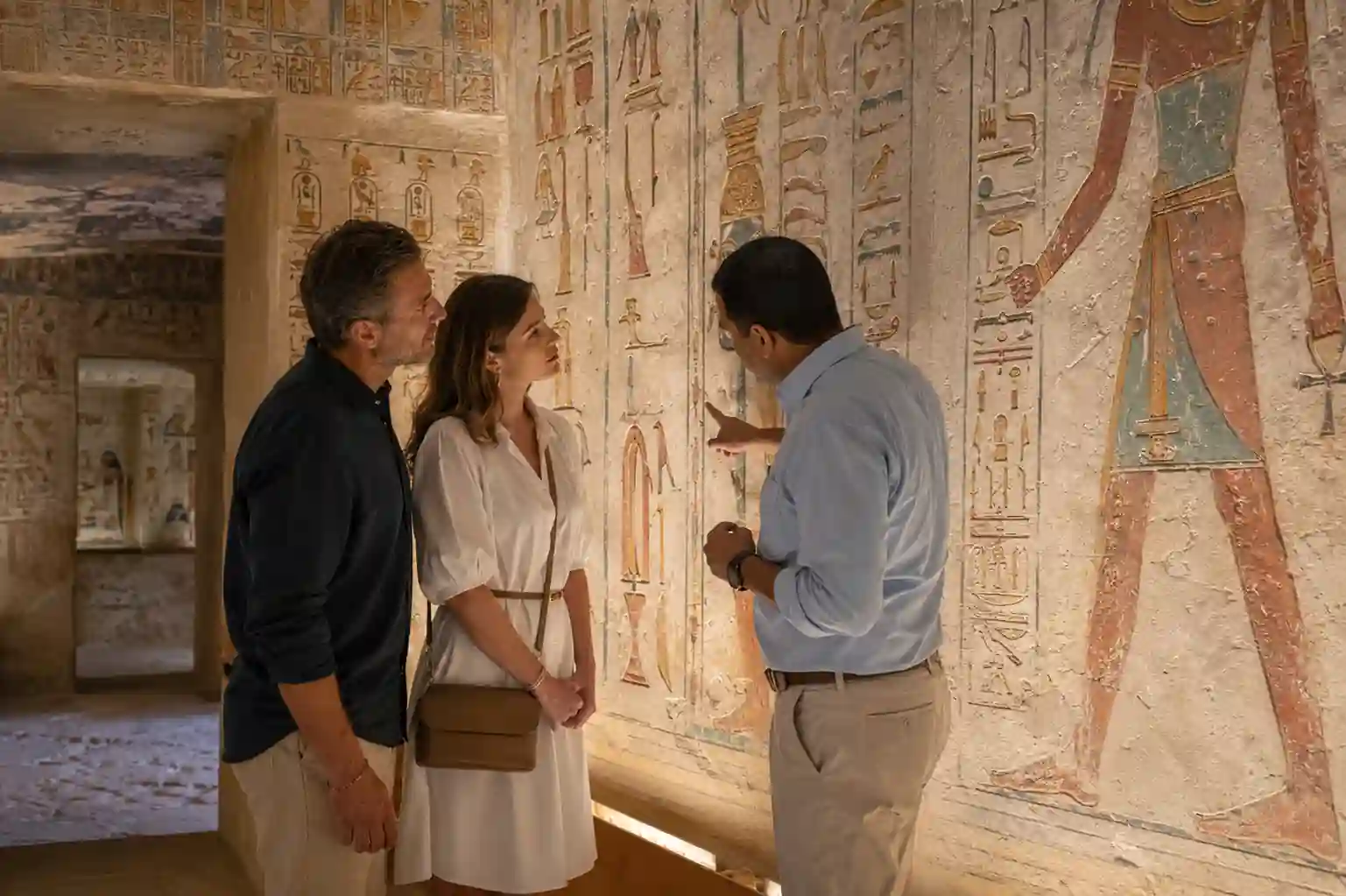
A private Egypt tour means one Egyptologist and one vehicle dedicated entirely to your traveling party whether that's two people or twelve for the full length of the journey. There is no shared guide, no fixed departure date, and no group pace. The itinerary, the timing at each site, and the pace of each day are built around what your party actually wants to see, not what a schedule needs to fit in.
That distinction sounds like a comfort upgrade. In practice, it's closer to a different category of travel entirely, because it changes something group tours structurally cannot: when you arrive at a site and how long you stay there. Most travelers researching Egypt for the first time assume "private" simply means fewer strangers on the bus. The more accurate way to understand it is that a private tour restructures the entire logic of the trip around time your time, not a schedule built to move the maximum number of people through the maximum number of sites in the shortest window.
What Actually Separates a Private Tour From a Group Tour
The difference isn't the vehicle or the hotel tier. It's control over time.
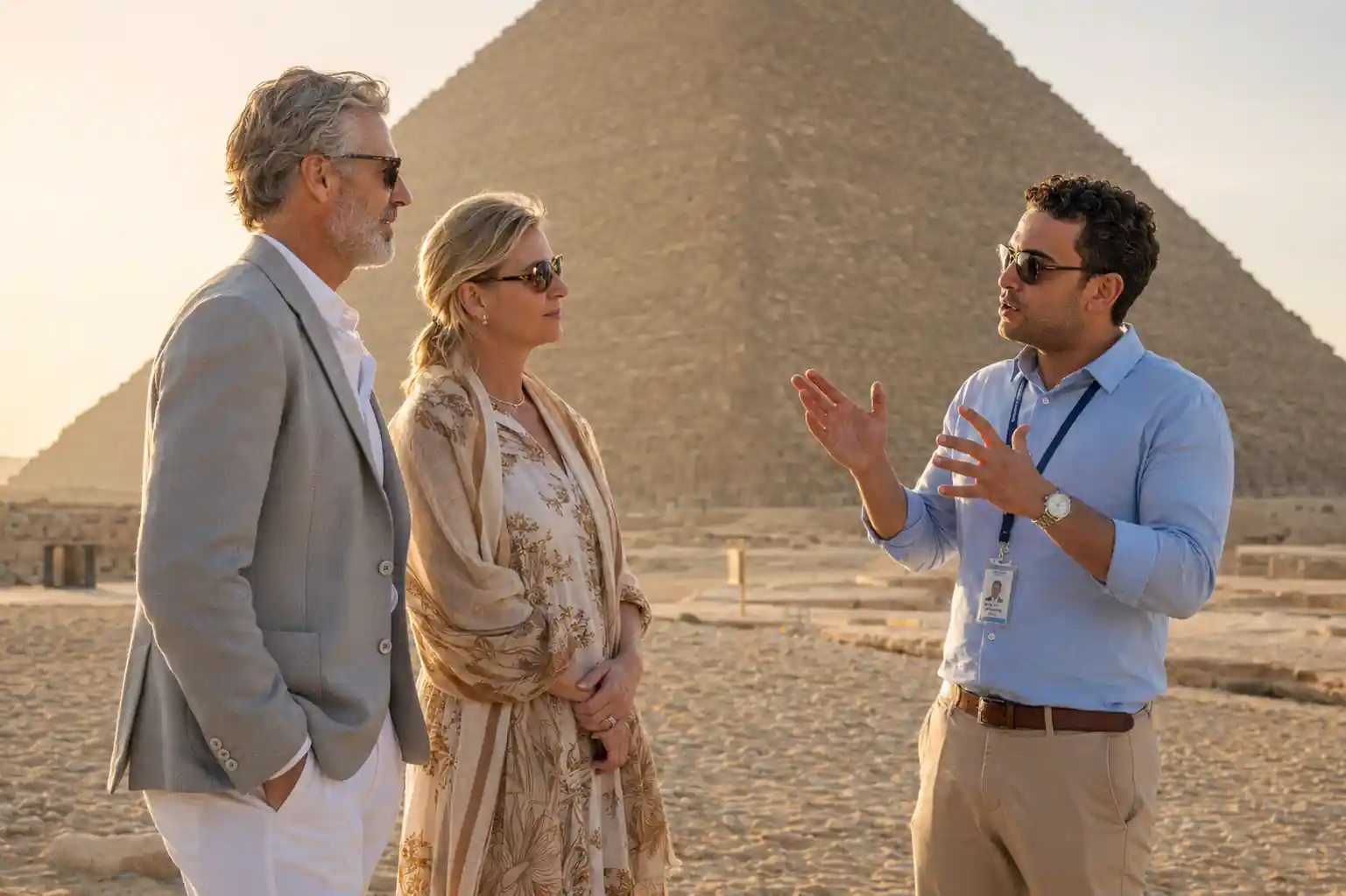
On a group departure, a guide is managing the schedules of everyone on the bus the group moves when the group needs to move, not when any one traveler is ready. Sites are visited in a fixed order, at fixed hours, because sixteen or thirty people need to be coordinated through security checkpoints, ticket lines, and bathroom breaks on a schedule that has to work for the least flexible member of the group. On a private Egypt tour, if your Egyptologist is mid-explanation of a wall relief in the Valley of the Kings and you want another twenty minutes there, you take it. If a site isn't holding your interest, you leave early and add that time somewhere that does.
This has a second-order effect that's easy to miss: on a private tour, your Egyptologist can also read the room. If your party is tired after an early flight, the afternoon can be softened. If two people in your group are architecture enthusiasts and the rest are more interested in mythology, a good Egyptologist alternates emphasis without losing anyone. None of that is possible when the guide is responsible for holding the attention of a mixed group of strangers with different interests and different stamina.
The contrast comes down to five things. Your guide: on a private tour, a dedicated Egyptologist stays with you for the full journey; on a group tour, the guide is shared across everyone on the bus. Site timing: private itineraries are scheduled around specific access windows, while group tours run on fixed hours shared with other operators. Pace: a private tour adjusts in real time to what your party wants, while a group tour moves at the pace of its slowest member. Your vehicle: private and exclusive to your party, versus a shared coach. And itinerary changes: possible day-of on a private tour, simply not possible on a fixed group departure.
How Private Access Actually Works: The Four Access Windows
This is the part most guides to Egypt skip, and it's the actual mechanism behind why a private tour feels different not just more comfortable.
Egypt's major sites have specific windows where a small private party can be positioned ahead of general admission. These aren't secret arrangements or paid favors; they're a function of timing and logistics that a fixed group departure, bound to a set daily schedule shared with dozens of other operators, simply cannot accommodate.
Giza, before public opening. A private vehicle can have your party at the plateau as the site opens, ahead of the tour buses that arrive on a fixed schedule roughly an hour later, once they've collected passengers from multiple hotels across Cairo. For that early window, visitor density at the Pyramids is a fraction of mid-morning levels, and the light is better for photography low, warm, and without the haze that builds up over Cairo by mid-morning.
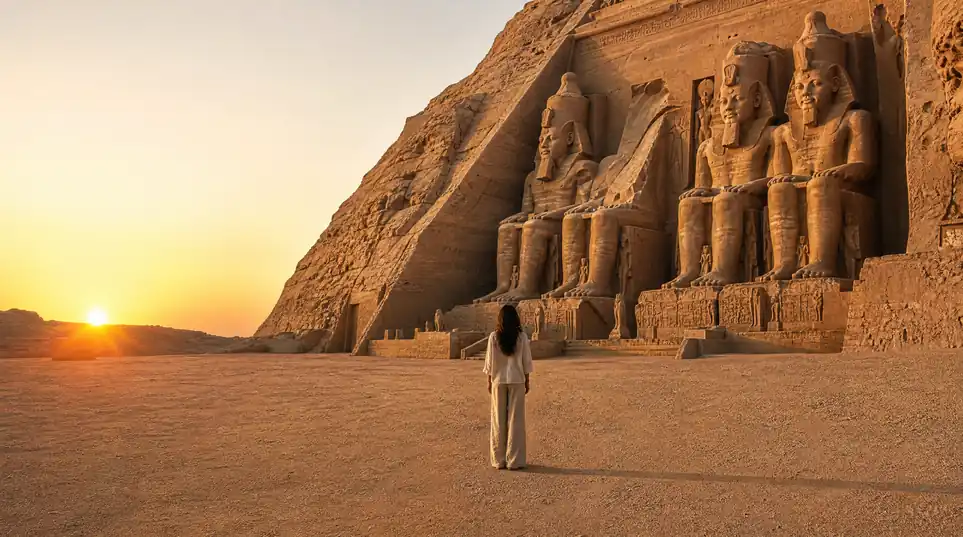
Abu Simbel, on the dawn charter. Commercial tour flights from Aswan to Abu Simbel run on a set daily schedule that typically lands after sunrise, once the temples are already open and filling with visitors who arrived by road overnight. A private charter can be timed to land earlier, putting your party inside the temple as the first light reaches the inner sanctuary the same alignment effect the temple was built to produce, without a crowd around you. This is arguably the single most requested experience among iLuxury Egypt's returning guests.
The Grand Egyptian Museum, off-peak entry. With over 100,000 artifacts on display across a museum built at a genuinely vast scale, movement matters as much as access. A private Egyptologist can time entry to avoid the coach-tour arrival blocks that cluster in the late morning, and let your party spend real, unhurried time in specific galleries the Tutankhamun collection, the solar boats rather than moving through on a fixed, pre-set route designed to keep large groups together.
Nile temples, on the morning cruise stops. Sites like Kom Ombo and Philae are visited by every vessel sailing the Luxor–Aswan route, but private and small-vessel itineraries can schedule arrival before the larger cruise ships dock the point at which these riverside temples are at their quietest, and when the light on the river is at its clearest for photography.
None of this requires special permission. It requires an operator who plans the itinerary around these windows rather than around a fixed departure grid shared with dozens of other buses and boats which is the actual, mechanical reason a private Egypt tour produces a different experience, not just a more comfortable one. This is worth stating plainly: the difference between a private and group Egypt tour is not luxury for its own sake. It is a difference in access to time and timing, which happens to also be more comfortable.
Who a Private Egypt Tour Is Actually Built For
Couples and honeymooners get access to moments the Pyramids at sunrise with no one else present, dinner on a Nile deck with only the river in view that are structurally unavailable on a shared departure. For couples specifically, the absence of strangers in photographs and the ability to slow down at a site that resonates emotionally (the entrance to Nefertari's tomb, for instance) tends to be what's remembered years later, more than any single monument.

Families traveling with children benefit from pace flexibility that isn't a nice-to-have but a practical necessity. An Egyptologist who has worked with families can shift the depth of explanation and the length of a stop based on the ages and energy levels in the group, without affecting other travelers on a shared bus. A ten-year-old and a sixty-year-old grandparent have very different tolerances for standing in the sun at Karnak at midday, and a private itinerary can be built around both.
Senior travelers can have a journey built around lower physical intensity site entry timing chosen to avoid heat and crowds, walking distances planned realistically, and transport choices selected specifically to reduce strain without reducing what they actually get to see. This is one of the most requested and most successful customizations iLuxury Egypt builds, because it addresses a real concern (can I physically manage this trip) without compromising the experience.
Travelers who want depth, not a photo stop, get a working relationship with an academic specialist for the length of the trip rather than a scripted explanation delivered to a group of sixteen strangers. If you've read about Egypt — Amarna period religious reform, the construction logistics of the pyramids, the decipherment of hieroglyphics a private Egyptologist can engage with that background directly, rather than delivering a generalized explanation pitched to the median visitor.
What Is a Private Egyptologist, and How Is That Different From a Tour Guide?
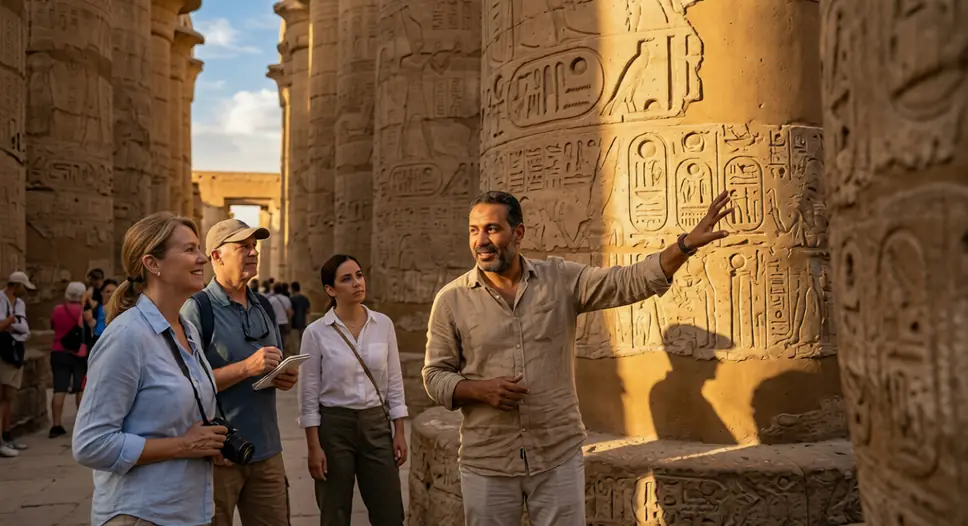
A licensed tour guide in Egypt is trained and certified to cover the country's major sites on a standard route, with a standard set of facts and explanations that satisfy the average visitor's level of curiosity. This is a legitimate and useful qualification, and most group tours are staffed entirely by guides at this level.
An Egyptologist holds an academic background in Egyptology or archaeology. That background is the practical difference: an Egyptologist can read hieroglyphic inscriptions directly off a tomb wall rather than reciting a pre-written summary, explain the astronomical alignment calculations behind sites like Abu Simbel and Karnak, and discuss the open scholarly debates about a monument — how a particular pharaoh's reign is currently understood, or where the evidence for a specific historical claim is contested rather than presenting one settled version of events as fact.
Your Egyptologist is matched to your specific interests during the pre-trip consultation funerary religion and belief systems, the engineering and astronomy of the monuments, political history across specific dynasties, or the archaeology of a particular period. This matching happens before you arrive, not on the day, and it's a genuine process: the consultation is designed to surface what you're actually curious about, not to assign whichever Egyptologist happens to be available that week.
Private Egypt Tour Itineraries by Length
7 days — Cairo, Luxor, Aswan. The essential route for travelers with limited time: Giza and the Grand Egyptian Museum, then Luxor's Valley of the Kings and Karnak, a Nile sail to Aswan, and Abu Simbel by private flight before departure. This itinerary requires no compromise on the major sites, though it leaves little room for spontaneous extra time at any single location.
10 days — the complete journey. The itinerary most first-time private Egypt travelers choose, and the one iLuxury Egypt recommends most often for a first visit. It adds a second Cairo day for the Egyptian Museum in Tahrir Square or Saqqara, and extends the Nile segment enough that each stop gets real time rather than a brief call between two longer transit days.
14 days — extended exploration. Room to add Alexandria's Greco-Roman history — the catacombs, the site of the ancient library or the White Desert and Siwa Oasis for travelers interested in Egypt beyond its archaeological core. Fourteen days is also where a private Dahabiya sailing, a slower and more intimate way to move along the Nile than a standard cruise vessel, becomes the practical choice rather than a stretch on the schedule.
5 days — Cairo focus. For travelers pairing Egypt with another destination or working within a tight window. A private sunrise Pyramids tour, the Grand Egyptian Museum, and Islamic Cairo, done properly, rather than an attempt at Upper Egypt done in a rush that undercuts the entire point of traveling privately.
Where You Stay on a Private Egypt Tour

Hotel selection is made for each destination based on location, service standard, and character not a fixed property list applied to every guest regardless of preference.
In Cairo and Giza, iLuxury Egypt typically selects from the Marriott Mena House, the Four Seasons First Residence, or the St. Regis Cairo each chosen for pyramid or Nile views and a distinct sense of historic character. In Luxor, the Sofitel Winter Palace, Al Moudira, and the Hilton Luxor are the standard options, selected for their Nile positioning and historic pedigree. In Aswan, the Sofitel Legend Old Cataract and the Movenpick Aswan are favored for their Nile views and historic significance. And for guests sailing the Nile itself, the choice is typically a private Dahabiya, the Oberoi Zahra, or a Sanctuary Sun Boat vessel, each selected for the level of intimacy and service standard it offers.
The distinction between a Dahabiya and a standard Nile cruise vessel is worth explaining, since it's frequently misunderstood. A Dahabiya is a traditional sailing vessel, historically the way wealthy travelers moved along the Nile before engine-powered cruise ships existed. It typically carries a small number of cabins often fewer than a dozen compared to the 60 to 100+ cabins on a standard cruise ship. It sails rather than motors where wind allows, moves at a markedly slower pace, and docks away from the larger tour-boat moorings, which changes both the sound of the journey and the timing of temple visits along the way.
Selections are confirmed and adjusted during the pre-trip consultation based on preference and availability at your specific travel dates, since the most sought-after properties and vessels have limited capacity, particularly across the peak winter months.
What's Included, and What Isn't
A private Egypt tour with iLuxury Egypt includes a dedicated senior Egyptologist for the full journey, a private air-conditioned vehicle and driver, arrival and departure transfers with a meet-and-greet option, five-star accommodation confirmed at each destination, domestic flights between cities, all entrance fees on the confirmed itinerary, a pre-trip consultation covering logistics and packing, and 24/7 concierge support throughout the journey.
Meals are typically arranged separately from the base itinerary your Egyptologist recommends restaurants suited to your taste and can join meals for continued conversation or step back entirely to give your party privacy, depending on preference. International flights to and from Egypt are arranged independently of the itinerary, since most guests already hold preferences or loyalty programs tied to specific airlines.
How Customization Actually Works
Every itinerary starts as a consultation, not a package selection. That conversation covers which destinations to include and how much time to give each, which Egyptologist fits your specific interests, hotel preferences at each stop, the rhythm of each day early starts with long site days, or a slower rhythm with more time at fewer locations and whether to extend the journey into Jordan, Saudi Arabia, or another regional destination.
Some travelers arrive at this consultation with a detailed sense of what they want: a specific dynasty, a specific type of accommodation, a specific pace. Others arrive with general interest in Egypt and no fixed plan beyond wanting to see it properly. Both starting points lead to the same kind of itinerary one built from the conversation rather than pulled from a template designed to fit the average traveler.
Why Book Through a Local Egypt Operator
The distinction shows up across five areas. Guide relationship: with a local operator, your Egyptologist is selected and briefed personally; through an international online agency, the guide relationship is typically subcontracted through a local partner you never speak to directly. Real-time changes: a local operator makes adjustments on the ground the same day, while an international agency routes changes through multiple parties. Local knowledge: a local operator has firsthand, current information on site conditions, while an international agency relies on periodic updates passed along from partners. Support during travel: a local operator is in your same time zone throughout the trip, while an international agency often has an international time-zone gap on urgent issues. And hotel relationships: a local operator typically holds direct relationships with properties, while an international agency books through intermediary systems.
The practical difference shows up most clearly when something needs to change mid-trip a flight delay, a site closure, a request to extend time somewhere. A local operator with a team on the ground in Egypt can restructure the following day directly. An international agency booking through a subcontracted local partner adds a layer of communication that slows down exactly the kind of real-time adjustment a private tour is supposed to offer in the first place.
When to Go: Matching the Season to Your Itinerary
October through April offers the most comfortable conditions across Egypt's outdoor sites, but the months within that window differ enough to matter for planning. November and January generally offer the strongest combination of temperature, clear light, and manageable visitor density at the Pyramids and Valley of the Kings. December and February bring slightly higher visitor numbers around the winter holidays, without meaningfully changing temperatures. March and April remain comfortable for most itineraries but bring warmer afternoons in Upper Egypt, which matters more for a Luxor or Aswan-heavy schedule than a Cairo-focused one. May through September is Egypt's hottest stretch, with Upper Egypt regularly exceeding conditions most travelers find comfortable for full days outdoors though a Cairo-only itinerary, timed around early mornings and evenings, remains workable even then.
Frequently Asked Questions
What is a private Egypt tour?
A journey where your Egyptologist, driver, and itinerary are dedicated entirely to your party for the full trip no shared guide, no fixed departure date, and no group pace to accommodate.
Are private Egypt tours worth the difference compared to group travel?
For travelers who want to control pace and site timing arriving at Giza before general admission, spending unhurried time in a specific tomb, sailing the Nile on a small private vessel the difference is structural, not just a comfort upgrade. It changes what you're able to see and when, not just how you get there.
Can a private Egypt tour be fully customized?
Yes. There's no fixed package every itinerary is built from a pre-trip consultation covering destinations, pace, Egyptologist matching, and hotel preference.
What's the difference between an Egyptologist and a tour guide?
A tour guide is licensed to cover Egypt's standard sites with standard explanations. An Egyptologist has an academic background in Egyptology or archaeology and can read inscriptions directly, explain astronomical alignments at sites like Abu Simbel, and discuss open scholarly debate rather than a fixed script.
Is Abu Simbel included on a private Egypt tour?
On itineraries of seven days or more, yes, typically by private charter flight from Aswan timed to arrive before the commercial tour flights land.
How far in advance should a private Egypt tour be booked?
For travel between November and February, three to six months ahead is the right window, mainly to secure a senior Egyptologist, preferred hotels, and Dahabiya availability. Shoulder-season travel needs less lead time two to three months is usually sufficient.
When is the best time for a private Egypt tour?
October through April offers the most comfortable conditions across Egypt's outdoor sites, with November and January generally offering the strongest combination of temperature, light, and lower visitor density at the Pyramids and Valley of the Kings.
Is a Nile cruise included in a private Egypt tour?
A Nile sailing segment between Luxor and Aswan is standard on itineraries of seven days or more. Vessel choice a private Dahabiya, a small luxury ship, or a larger cruise vessel is confirmed during the pre-trip consultation based on group size and preference.
Every private Egypt journey begins with a single conversation about what you want to experience not a quote.
Start Your Private Egypt Consultation →