Most egypt packing list articles are written for budget backpackers. They tell you to bring a money belt, a padlock, and a fast-dry towel. If you are traveling to Egypt on a private itinerary, staying at the Marriott Mena House or the Old Cataract in Aswan, and spending your days with a private Egyptologist rather than navigating group tours, that advice does not apply to you.
This guide is written for American travelers on private Egypt journeys. It tells you what to actually bring, why each item matters in the specific context of Egypt, what the five-star hotels and Nile cruises you will be staying on already provide, and what experienced travelers consistently wish they had left at home. Every recommendation is based on the realities of the Egyptian climate, the dress expectations of the sites you will visit, and the service standards of the properties where you will be staying.
Egypt is not a difficult destination to pack for. But it is a specific one and the difference between packing well and packing wrong becomes apparent about forty-eight hours into the trip, when you are either comfortable and prepared or scrambling to find something in a Cairo pharmacy.
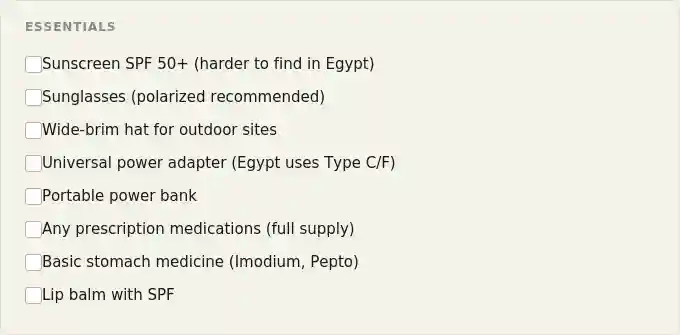
Quick Egypt packing checklist — the essentials
Everything here is expanded in detail below. This overview is for travelers who want the summary first.
Documents — what you need and why
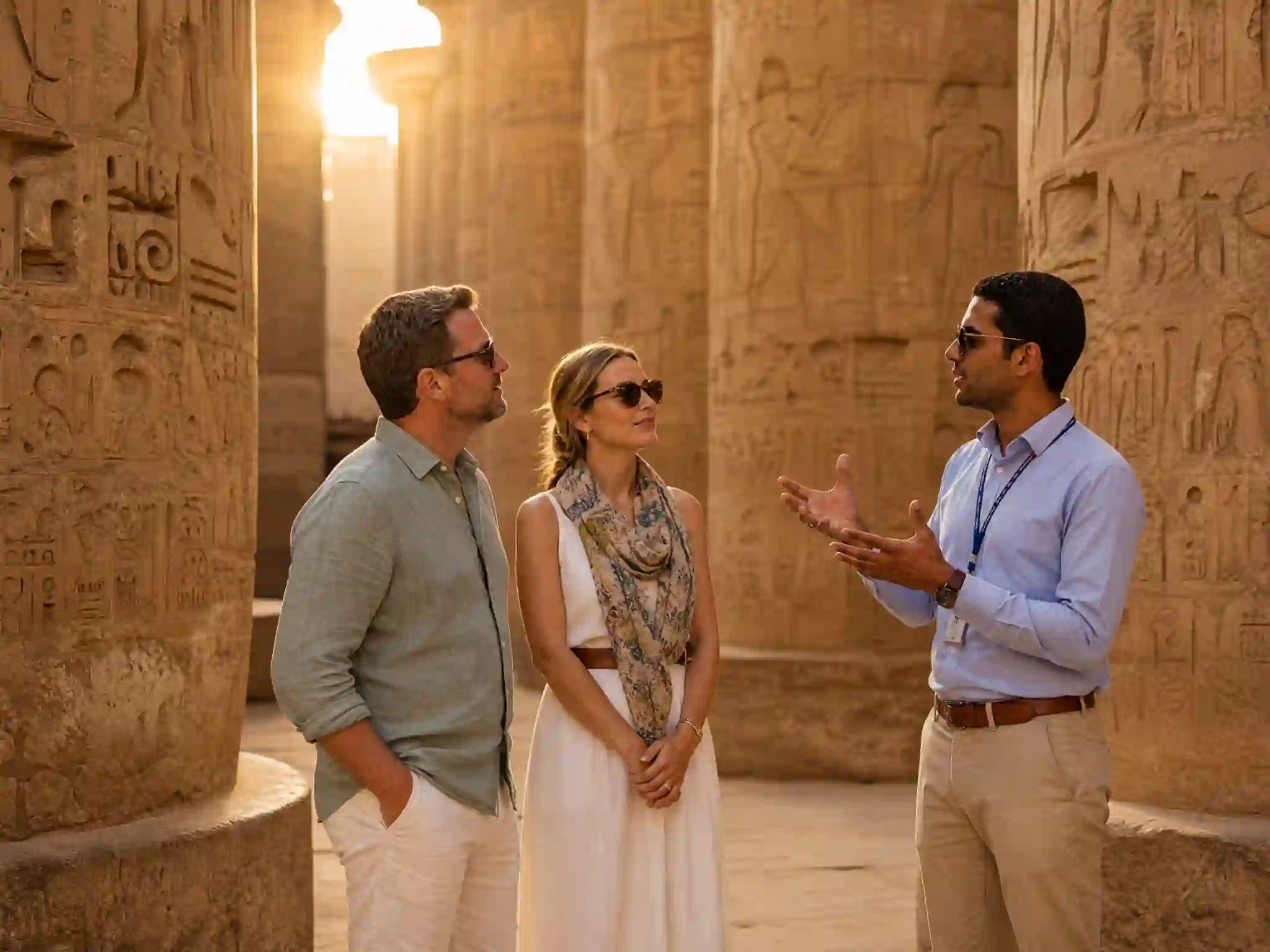
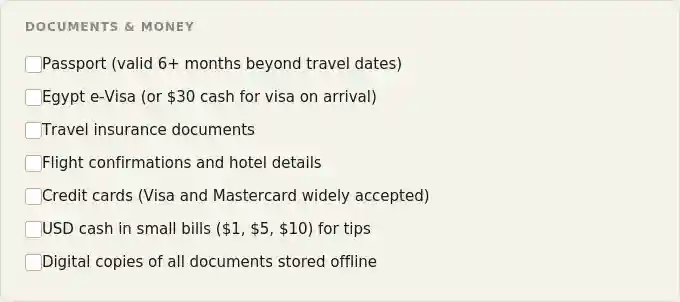
Your passport must be valid for at least six months beyond your travel dates. Egyptian immigration enforces this requirement, and airlines will not board passengers whose passport validity falls short. Check your expiration date before you book.
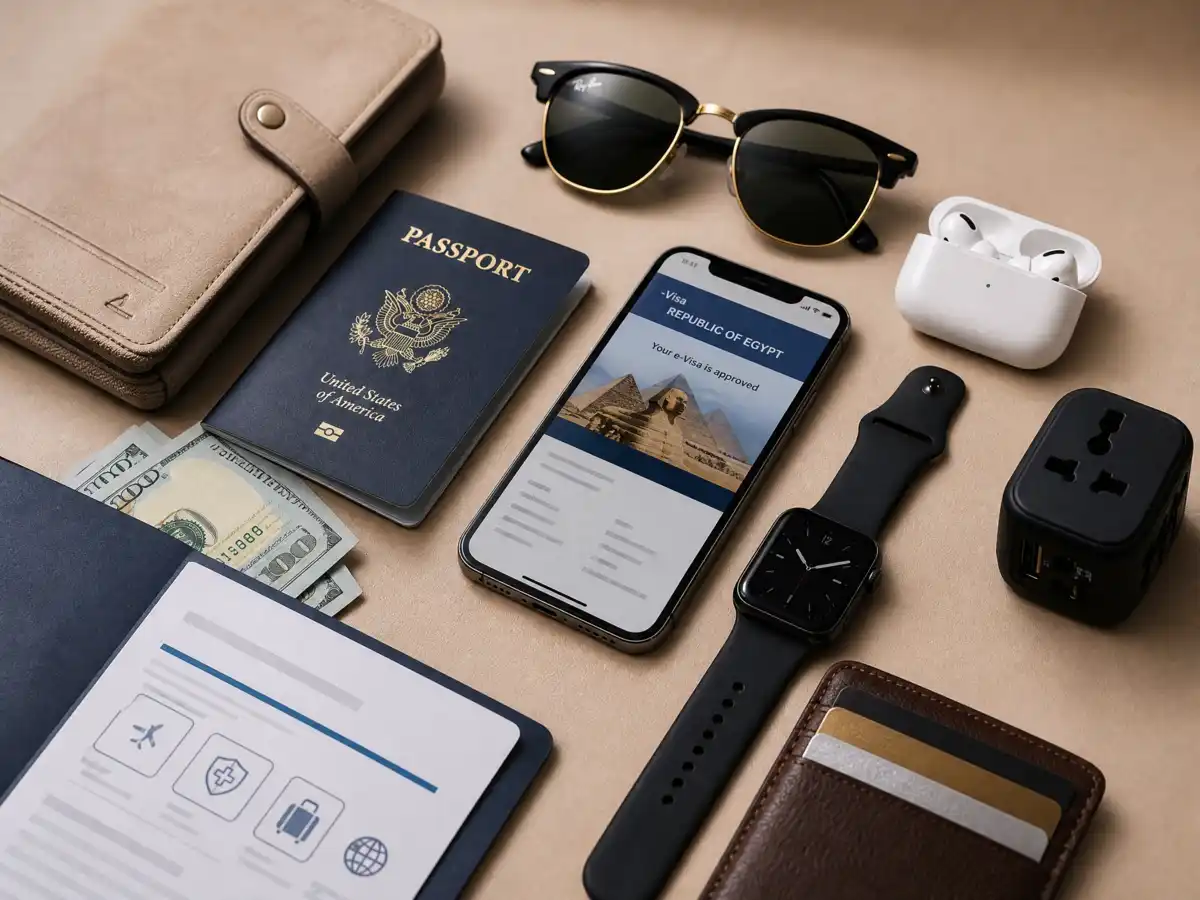
US citizens have two options for the Egypt visa. The e-Visa, obtained online before travel through the Egyptian government portal, costs approximately $25 and is processed within 24–72 hours. The visa on arrival, available at Cairo International Airport, costs $30 USD and is paid at a bank counter before immigration a straightforward process that takes fifteen to twenty minutes. Both are equally valid. Your iLuxury Egypt team will advise which is more practical for your specific travel dates and routing.
Travel insurance is not a bureaucratic formality for Egypt travel it is a practical necessity. Medical care at the level appropriate for international travelers is available in Cairo, but the logistics of accessing it without insurance coverage are complicated. Choose a policy that includes emergency medical evacuation, trip cancellation, and international coverage. Your iLuxury Egypt team can provide guidance on appropriate policies during your pre-trip consultation.
Carry digital copies of all critical documents passport, visa, insurance policy, flight confirmations, hotel details stored offline on your phone and in a cloud service your travel companion can also access. Print copies are worth bringing as backup. In twenty years of arranging private Egypt itineraries, lost passports and forgotten confirmation numbers have caused more disruption than any security or safety issue.
Money — cash, cards, and tipping in Egypt
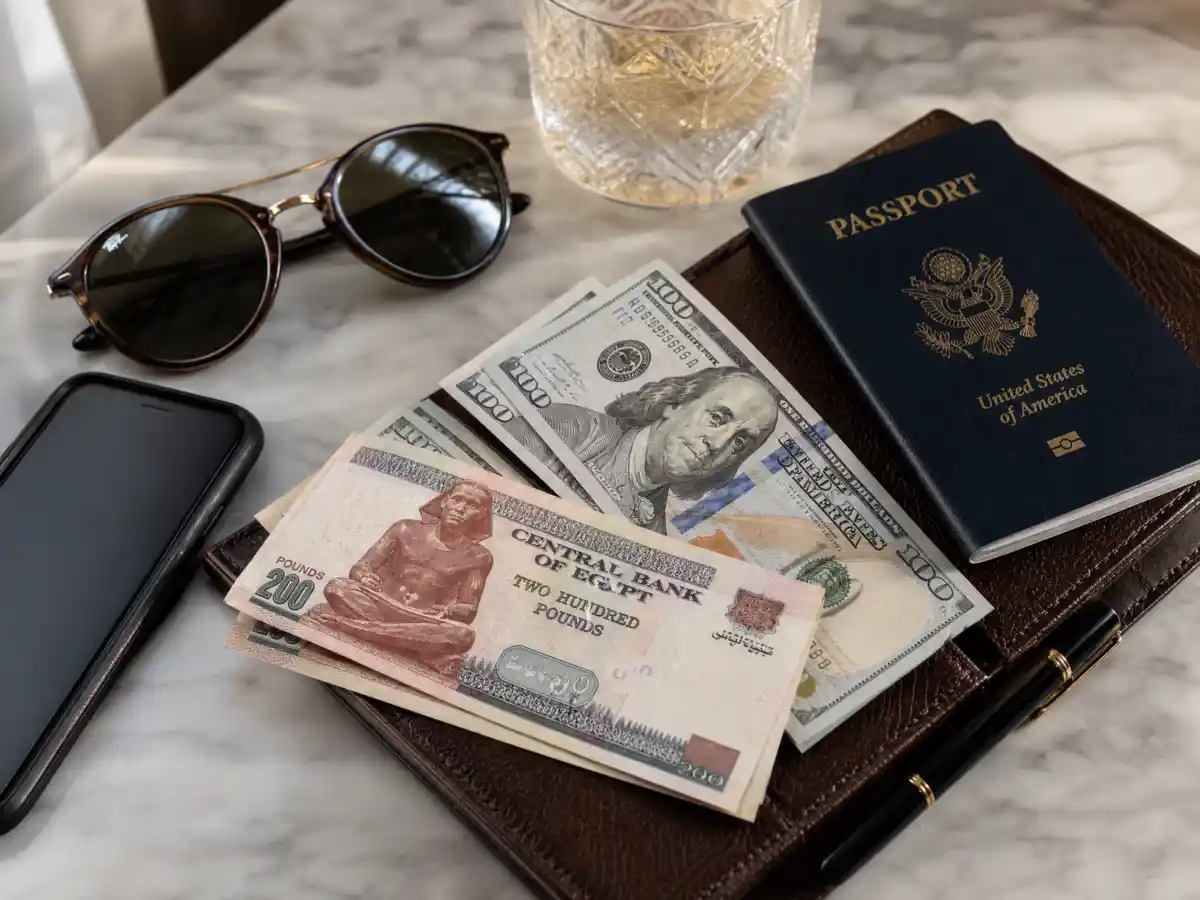
Egypt operates on a dual-currency reality for international travelers. Major hotels, restaurants, and tour operators accept Visa and Mastercard without issue. American Express is accepted at luxury properties. For everything else tips, small purchases, market transactions Egyptian pounds are used, and cash is essential.
The most practical approach for iLuxury Egypt guests is to bring a supply of US dollars in small bills ($1, $5, and $10 denominations) and exchange a portion on arrival. USD is widely accepted at hotels and can be exchanged at airport banks, hotel desks, or authorized exchange offices. ATMs are available throughout Cairo, Luxor, and Aswan, though rural areas between sites may have limited access.
Tipping in Egypt is culturally significant and practically important. Your private guide, driver, hotel staff, and anyone who assists you throughout the journey will expect and appreciate a tip. The standard for a private Egyptologist is $20–30 USD per day. Drivers typically receive $10–15 per day. Hotel porters, $2–5 per bag. Carrying small bills in a dedicated pocket separate from your main wallet makes the process natural rather than awkward.
Apple Pay and Google Pay are accepted at some upscale Cairo establishments but are not reliable enough to depend on. Do not assume contactless payment will work outside of five-star hotel environments.
Clothing — what to pack for Egypt's specific conditions
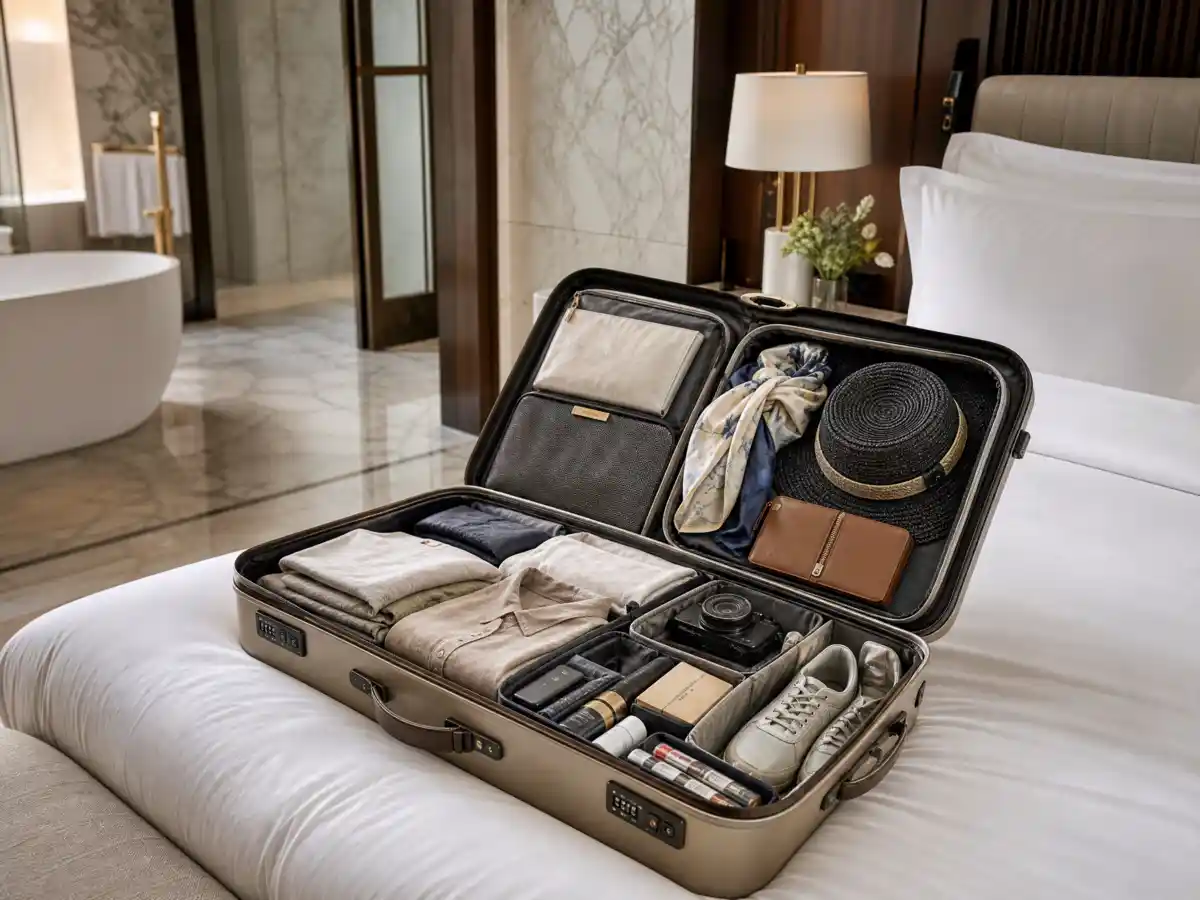
Egypt's clothing requirements are governed by three factors that most packing guides underweight: the intensity of the sun at archaeological sites, the dress expectations at temples and mosques, and the smart-casual standard expected at the dining rooms of the properties where you will be staying.
What to wear at archaeological sites
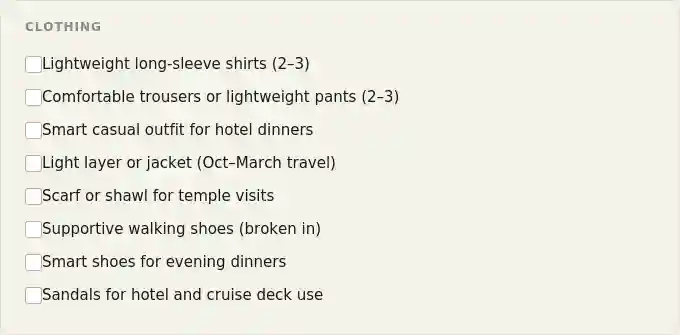
The Giza Plateau, the Valley of the Kings, Karnak Temple, and Abu Simbel all involve significant time outdoors, often with little shade, on surfaces that reflect heat. Even in January the coolest month the midday sun at Giza is stronger than most American travelers expect from a winter trip. Lightweight, long-sleeve shirts in natural fabrics (linen and cotton breathe; synthetics do not) provide sun protection while remaining cooler than short sleeves in direct sunlight. This is not a comfort preference it is a practical reality that experienced Egypt travelers universally confirm.
You will walk on uneven limestone at Giza, polished stone paths at Luxor temples, sandy ground at Abu Simbel, and occasionally narrow passages inside tombs in the Valley of the Kings. One pair of genuinely supportive walking shoes broken in before the trip, not new from a box is the single most important clothing item on this egypt packing list. Blisters on day two of a ten-day itinerary affect every day that follows.
What to wear at temples and mosques
Egypt's ancient temples have no dress code shorts and sleeveless tops are worn by visitors without issue. Islamic sites mosques, particularly in Cairo's Islamic quarter require covered shoulders and knees for both men and women, and women are expected to cover their hair. A lightweight scarf that packs flat is the most versatile solution. It covers shoulders at mosques, provides sun protection at open sites, and adds a layer of warmth on cooler evenings on a Nile cruise deck.
What to wear at luxury hotels and Nile cruises
The dining rooms at the Marriott Mena House, the Old Cataract Aswan, the Four Seasons Cairo, and comparable properties operate at a smart-casual standard for dinner. Jeans are generally acceptable if clean and paired with a collared shirt or blouse. Shorts and athletic wear are not appropriate for hotel dining rooms or formal meals on a private Nile cruise. One smart outfit a blazer and trousers for men, a dress or smart separates for women covers every dinner situation you will encounter on a luxury Egypt itinerary.
Packing by season
October through February: Days are warm to mild (65–80°F at sites), evenings can be genuinely cold, particularly in Aswan and on the Nile after sunset. A light jacket or layering piece is worth packing for this travel window not heavy, but real. January mornings at Giza before sunrise carry a chill that surprises many American visitors.
March through May: Warm and increasingly hot. Lightweight clothing throughout. The Khamsin a hot desert wind carrying fine sand can occur in March and April. A buff or lightweight scarf that covers the face is useful during these weeks.
June through September: Very hot at archaeological sites (95–115°F in Luxor and Aswan). Private itineraries in summer are structured to visit sites early morning and late afternoon, avoiding midday outdoor exposure. Lightweight, loose, light-colored clothing is essential.
Luxury travelers — what your hotels already provide
One of the consistent packing mistakes made by travelers staying at Egypt's top properties is bringing items that the hotels supply at a higher quality than anything you would pack. Before adding the following to your egypt packing list, confirm with your iLuxury Egypt team what is provided at each property on your specific itinerary.
Properties at the level of the Marriott Mena House, Old Cataract Aswan, Four Seasons Cairo, and Oberoi Zahra Nile Cruise typically provide high-quality shampoo, conditioner, and body wash; hair dryers; bathrobes and slippers; daily laundry service; and in many cases, a selection of toiletries on request. Bringing full-sized bottles of toiletries to these properties adds weight to your luggage for no practical reason.
What these properties do not provide, and what is worth bringing: your specific prescription medications (pharmacies in Egypt can be difficult to navigate for specific formulations), any particular sunscreen you depend on (SPF 50+ is available in Egypt but specific brands may not be), and any specialized electronics or photography equipment.
Electronics — the practical list

Egypt uses Type C and Type F power outlets, operating at 220V/50Hz different from the US standard of 110V/60Hz. A universal power adapter is essential. Most modern electronics (laptops, phone chargers, cameras) are dual-voltage and work with an adapter alone. Older devices some hair dryers, electric shavers may require a voltage converter. Check the label on your device before assuming.
A portable power bank is worth prioritizing. Long days at outdoor sites, with GPS, camera, and communication apps running, drain phone batteries faster than a standard day. A 20,000mAh bank provides two to three full phone charges and fits in a day bag.
If you plan to photograph seriously at the Pyramids, in the Valley of the Kings, or on the Nile at sunset, Egypt rewards preparation. The light at Giza at sunrise, the interior light in certain Luxor tombs, and the Nile at golden hour are among the most photographable conditions in the world. Extra memory cards and a spare camera battery are worth the weight. Drone photography at the Giza Plateau requires permits that are difficult to obtain and are frequently denied do not plan on flying a drone at the major sites.
Medicine and health — what to bring
Bring a full supply of any prescription medications you take regularly. While pharmacies exist in Cairo and the major cities, tracking down a specific medication formulation in the correct dosage is time-consuming and sometimes impossible. Enough medication for your trip plus a five-day buffer is the appropriate approach.
Traveler's diarrhea is a possibility on any international trip, including Egypt. Even with careful eating habits at top-tier properties, a change in diet, water, and environment can affect digestion. Imodium and a rehydration solution (Pedialyte packets or similar electrolyte powder) weigh almost nothing and resolve most stomach issues quickly if they arise.
Egypt's major cities have modern hospitals and clinics with English-speaking staff at the international visitor level. Medical emergencies at archaeological sites are a different matter distance from care is the primary concern, not quality of care once you reach it. Travel insurance with medical evacuation coverage addresses this gap.
What NOT to pack for Egypt
This section of the egypt packing list is, for most travelers, as useful as the sections above.
Heavy luggage is the most common packing mistake on a multi-city Egypt itinerary. You will transfer between Cairo, Luxor, and Aswan often on domestic flights with strict baggage allowances. A lighter bag also means faster movement at archaeological sites, easier loading into vehicles, and significantly less physical fatigue across a ten-day journey.
Expensive jewelry and watches are worth leaving at home. Not because Egypt is unsafe it is not but because the practical experience of wearing a Rolex at the Valley of the Kings in July heat adds no value to the experience and adds unnecessary concern. The same applies to expensive camera equipment that you are not committed to using properly. A mid-range mirrorless camera used well produces better photographs than a professional system carried anxiously.
A hair dryer, full-sized toiletries, and multiple pairs of shoes are consistently the items travelers wish they had left behind. The hotels provide the first, the luggage weight argues against the second, and one good pair of walking shoes and one pair of smart shoes cover every situation on a private Egypt itinerary.
Things American travelers consistently forget
Based on the pre-trip consultations iLuxury Egypt conducts with American guests, these are the items most frequently overlooked on an egypt packing list and most inconvenient to source in Egypt.
Small-denomination USD bills for tipping $1 and $5 notes specifically. These are genuinely difficult to use if all you have are $50 and $100 bills, and breaking large notes for tips creates awkwardness that small bills eliminate entirely.
A universal power adapter. Egypt's outlet type is not compatible with US plugs, and while adapters are available in Cairo, finding one on arrival after a fourteen-hour flight is an unnecessary start to the trip.
Lip balm with SPF. The combination of dry desert air and direct sun affects lips quickly, and this is consistently an item travelers either forget or underestimate. SPF lip balm is available in Egypt but not always at the properties where you need it.
A lightweight day bag for site visits separate from your main luggage. A small, packable bag that carries water, sunscreen, phone, and camera during site visits keeps your hands free and your main luggage at the hotel. Most travelers arrive without one and spend the first day wishing they had it.
Nile cruise packing specifics
A Nile cruise particularly a private Dahabiya has its own packing considerations. Evenings on the Nile after sunset are cooler than the daytime temperatures suggest, and a light jacket or wrap is worth having on deck. The movement of a river vessel is gentle but present, and travelers who are sensitive to motion may benefit from bringing seasickness medication, though most guests do not require it.
Binoculars are worth considering for a Nile cruise. The river banks between Luxor and Aswan contain villages, bird life, and occasional temple ruins that are visible from the deck a compact pair adds relatively little weight and significantly enhances time spent on the water between stops.
Frequently asked questions
Do I need to dress conservatively throughout Egypt?
At ancient Egyptian archaeological sites the Pyramids, the Valley of the Kings, Karnak there is no dress requirement. At Islamic sites, covered shoulders and knees are required, and women should cover their hair. At luxury hotels and restaurants, smart-casual is the standard for evenings. A lightweight scarf covers all situations where modesty is needed.
Can I find sunscreen in Egypt?
SPF sunscreen is available at pharmacies and some hotel gift shops in Cairo, Luxor, and Aswan. However, high-SPF options in the specific formulations American travelers prefer mineral, reef-safe, particular brands may not be consistently available. Bringing your own preferred SPF 50+ sunscreen is the reliable approach.
What plug type does Egypt use?
Egypt uses Type C and Type F outlets, operating at 220V/50Hz. A universal power adapter is required for US plugs. Most modern electronics are dual-voltage and work with an adapter alone check your device label before assuming you need a voltage converter.
Should I bring cash to Egypt?
Yes specifically US dollars in small denominations ($1, $5, $10) for tipping, and either Egyptian pounds or USD for small purchases. Credit cards (Visa and Mastercard) are accepted at luxury hotels, upscale restaurants, and major tour operators. Cash remains essential for tips and smaller transactions throughout the journey.
Can I wear shorts in Egypt?
At ancient archaeological sites, yes. At Islamic religious sites, no covered knees are required. At luxury hotels and restaurants, shorts are generally not appropriate for evening dining. Lightweight trousers or pants serve all three contexts and are the more practical choice for a private Egypt itinerary.
Do Egypt's luxury hotels provide hair dryers?
Yes. All five-star properties the Marriott Mena House, Old Cataract Aswan, Four Seasons Cairo, and comparable hotels provide hair dryers in rooms. Bringing one adds weight to your luggage for no practical reason.
Can I bring a drone to Egypt?
Drone photography at major archaeological sites including the Giza Plateau requires government permits that are difficult to obtain and frequently denied. Do not plan your photography around drone footage at these locations. Photography from ground level at the sites is permitted and produces extraordinary results.
How many outfits should I pack for a 10-day Egypt trip?
For a private 10-day egypt itinerary: three to four pairs of lightweight trousers or pants, four to five lightweight tops, one smart outfit for evening dining, one light jacket or wrap (for October–March travel), one scarf, one pair of walking shoes, one pair of smart shoes, and sandals for hotel and cruise use. Laundry service is available at all five-star properties, so packing for the full duration is unnecessary.
Planning a private Egypt journey and want guidance on exactly what your specific itinerary requires? Your iLuxury Egypt pre-trip consultation covers everything including a packing briefing tailored to your dates, destinations, and the properties where you will be staying.