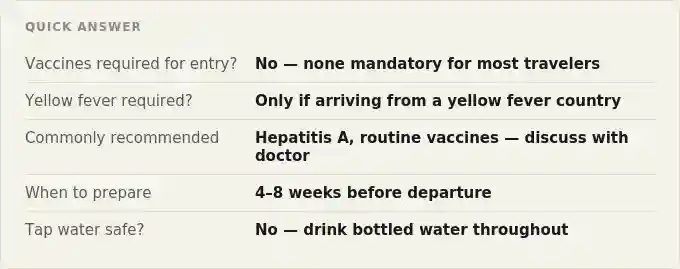
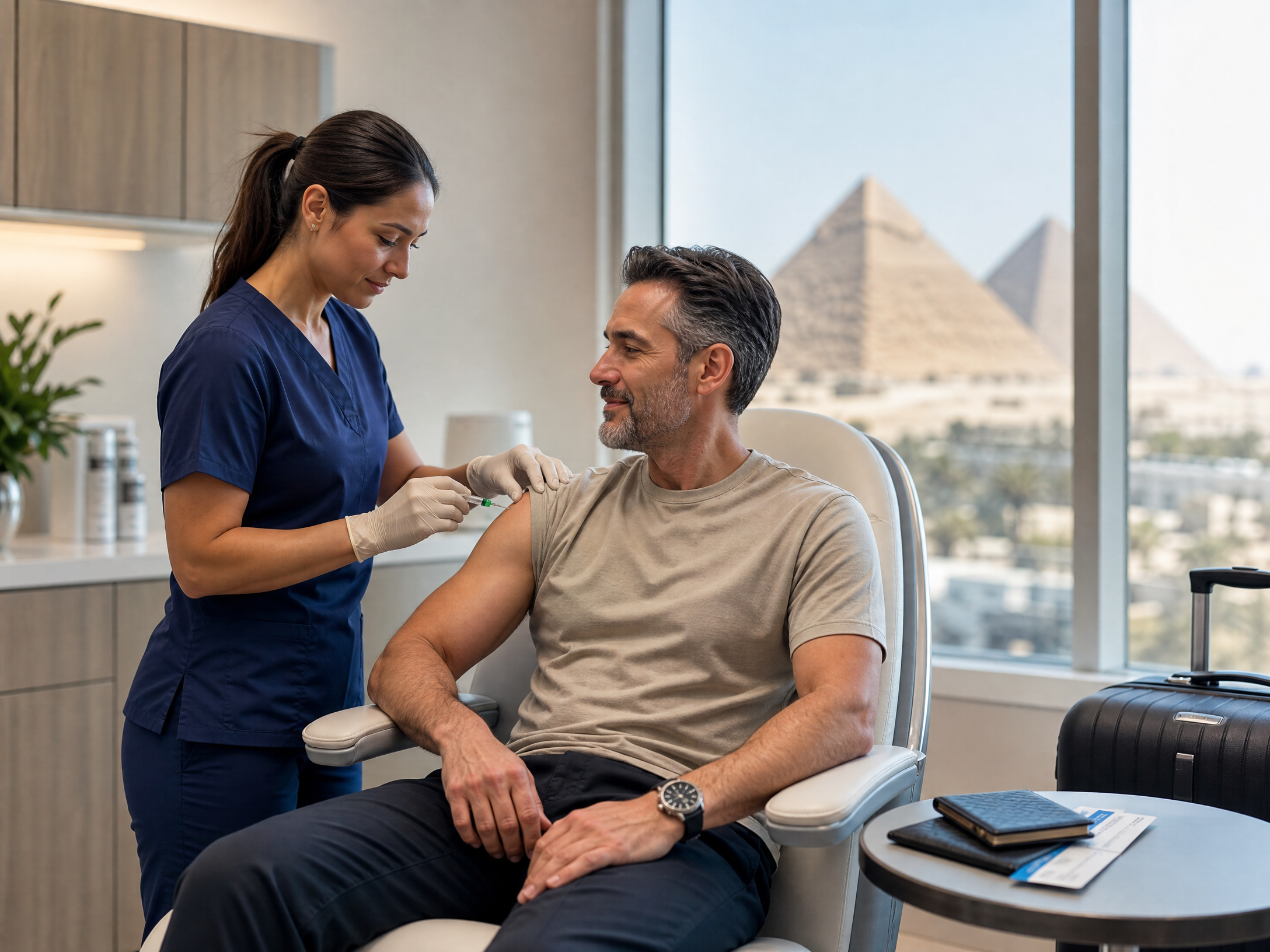
For the vast majority of American travelers, vaccines for egypt travel are not a complicated subject. Egypt does not require proof of vaccination for entry from the United States, and the country is not associated with the serious infectious disease risks that make some destinations require extensive pre-travel medical preparation. That said, a conversation with your doctor or a travel medicine clinic four to eight weeks before departure is a worthwhile investment of thirty minutes particularly if you have underlying health conditions, are traveling with children or older adults, or plan to spend time outside Egypt's major cities.
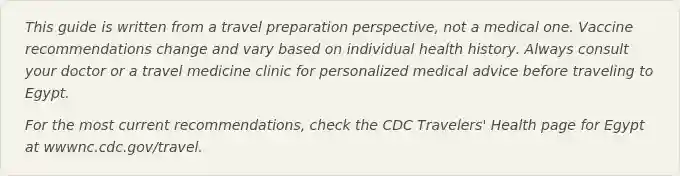
This guide is written from a travel preparation perspective. It tells you what questions to bring to that medical appointment, what practical health steps experienced Egypt travelers take regardless of vaccination status, and how a well-arranged private itinerary reduces many of the health friction points that affect travelers on group tours.

Are any vaccines required to enter Egypt?
For travelers arriving directly from the United States, no vaccines are required for entry to Egypt. Egyptian border control does not check vaccination records for US citizens arriving on a standard tourist visa or e-Visa.
The one exception involves yellow fever. Travelers arriving in Egypt from countries where yellow fever is endemic primarily certain countries in sub-Saharan Africa and South America may be required to show proof of yellow fever vaccination. If your Egypt trip follows travel to any of these countries, check the current requirements through the CDC or your travel medicine provider before departure. This requirement does not apply to travelers arriving directly from the United States.
Vaccines commonly recommended for Egypt — what to discuss with your doctor
The following reflects general guidance commonly provided to travelers visiting Egypt. Individual recommendations depend on your health history, age, vaccination record, and the specific nature of your trip. Your doctor or travel medicine clinic will advise based on your specific situation.
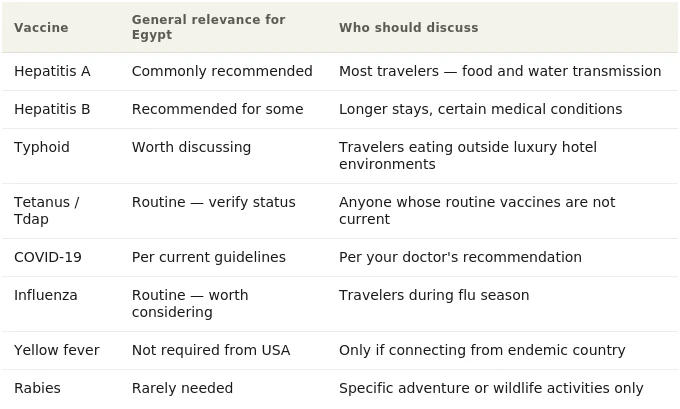
The most important action is confirming that your routine vaccinations are current. Tetanus, MMR (measles, mumps, rubella), and varicella are the most commonly overlooked not because Egypt poses specific risks, but because adult booster schedules are frequently not kept current. Your doctor's appointment before Egypt is a good opportunity to review your complete vaccination record.
When to start health preparation before Egypt travel
The standard guidance from travel medicine providers is to begin health preparation four to eight weeks before departure. Some vaccines require multiple doses spaced weeks apart to reach full effectiveness Hepatitis A and B combined vaccines, for example, follow a schedule that requires planning ahead. Starting your preparation eight weeks out gives you full flexibility regardless of what your doctor recommends.
If you are traveling in less than four weeks, a travel medicine appointment is still worthwhile. Single-dose vaccines and medications can be prescribed on a compressed timeline, and the appointment itself covering food safety, water precautions, and what to do in case of medical need in Egypt is valuable regardless of vaccination decisions.
The CDC Travelers' Health page for Egypt (wwwnc.cdc.gov/travel/destinations/traveler/none/egypt) is updated regularly and provides the most current official recommendations. Check it as part of your pre-trip preparation, and bring any questions it raises to your doctor.
Food and water safety in Egypt
This is the practical health area most relevant to the day-to-day experience of traveling in Egypt, and the one where simple habits make the most significant difference.
Water
Tap water in Egypt is not recommended for drinking by international travelers. This is not specific to budget travel the standard applies regardless of where you are staying. All of Egypt's five-star hotels and luxury Nile cruises provide bottled water in rooms and throughout the property as standard. Your iLuxury Egypt private vehicle carries bottled water for site visits. Maintaining this consistently bottled water throughout, including for brushing teeth in some situations is the single most effective health habit on an Egypt trip.
Ice at luxury hotel bars and restaurants is typically made from purified water and is generally considered safe at five-star properties. Ice from unknown sources in local settings is a different calculation. Your Egyptologist and iLuxury Egypt team can advise on specific situations as they arise during your journey.
Food
Egypt's five-star hotels and the upscale restaurants that iLuxury Egypt includes in private itineraries maintain food safety standards that are consistent with international expectations. Dining within this environment carries a level of assurance that street food and local market food does not.
Fresh fruits and vegetables served at luxury properties are washed appropriately and are generally safe to eat. The standard precaution avoiding raw produce that cannot be peeled, at establishments where food handling practices are uncertain applies primarily to eating outside the luxury hotel and restaurant environment, which is most relevant for travelers exploring local markets independently.
Egyptian cuisine at quality restaurants is genuinely excellent and worth exploring. The practical approach is to discuss any specific dietary concerns or food allergies with your iLuxury Egypt team during the pre-trip consultation they can communicate your requirements to every restaurant and property on your itinerary in advance.
Staying healthy during a private Egypt journey
The following practical habits are what experienced Egypt travelers consistently identify as the most effective health maintenance measures across a ten-day itinerary.
Hydration
Egypt's climate dry, hot, and at many sites fully exposed to the sun creates dehydration faster than most American travelers expect, particularly in the first two or three days before acclimatization. A simple rule: drink more water than you think you need at every outdoor site, regardless of whether you feel thirsty. Your iLuxury Egypt vehicle carries bottled water throughout the day precisely for this reason.
Sun protection
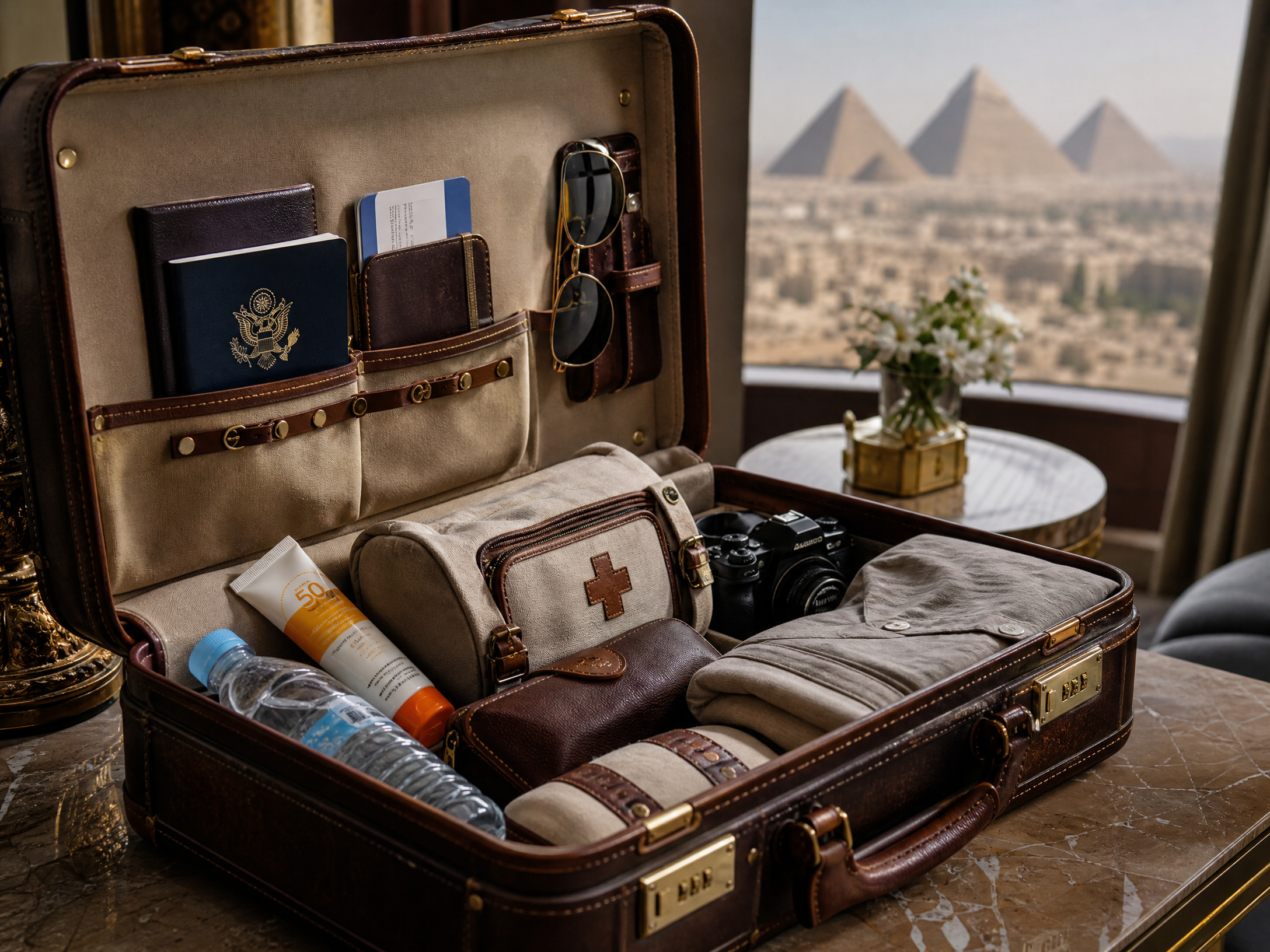
The Giza Plateau, the Valley of the Kings, Karnak Temple, and Abu Simbel all involve significant time outdoors, often with minimal shade. Even in January, the midday sun in Luxor and Aswan is stronger than most American travelers experience at home. SPF 50+ sunscreen, a hat with a brim, and lightweight long-sleeve clothing are more effective than relying on intermittent shade.
Prescription medications
Bring a full supply of any prescription medication you take regularly, plus a five-day buffer beyond your travel dates. While pharmacies exist in Cairo, Luxor, and Aswan, finding a specific medication formulation in the correct dosage is time-consuming and sometimes impossible. Keep medications in your carry-on luggage, not checked baggage both to prevent loss and to ensure access during a long flight.
If you take medications that require refrigeration, discuss storage arrangements with your iLuxury Egypt team during the pre-trip consultation. Five-star hotel rooms and Nile cruise cabins have refrigerators; specific arrangements for temperature-sensitive medications can be confirmed at each property in advance.
Stomach health
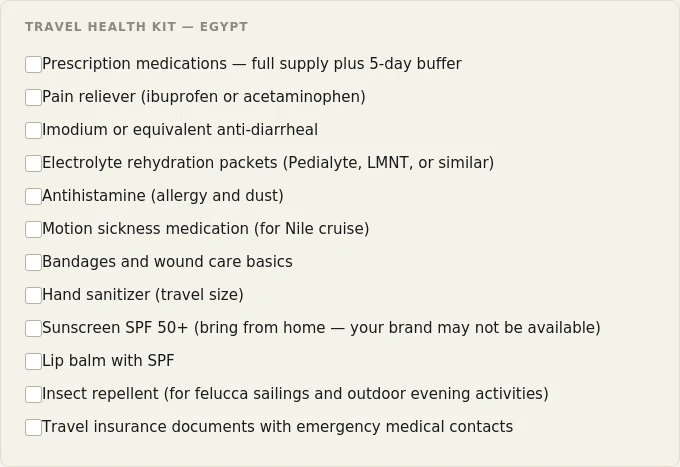
Traveler's diarrhea is a possibility on any international trip, including Egypt. Even travelers who are careful about water and food can experience digestive disruption from a change in diet, different mineral content in the water supply, or simply the adjustment of traveling across multiple time zones. Carrying Imodium and electrolyte rehydration packets available over the counter in the US and worth including in your travel health kit resolves most cases quickly. Your doctor can also prescribe an antibiotic for self-treatment of more serious cases, which many travel medicine physicians recommend for travelers going to destinations where medical access may be delayed.
Travel health kit for Egypt
How a private Egypt itinerary reduces common health risks
Many of the health situations that affect travelers in Egypt are related to logistics rather than destination-specific risks exposure to large crowds at archaeological sites, shared transportation, uncertainty about food sources, and the physical fatigue of managing an unstructured itinerary in unfamiliar conditions.
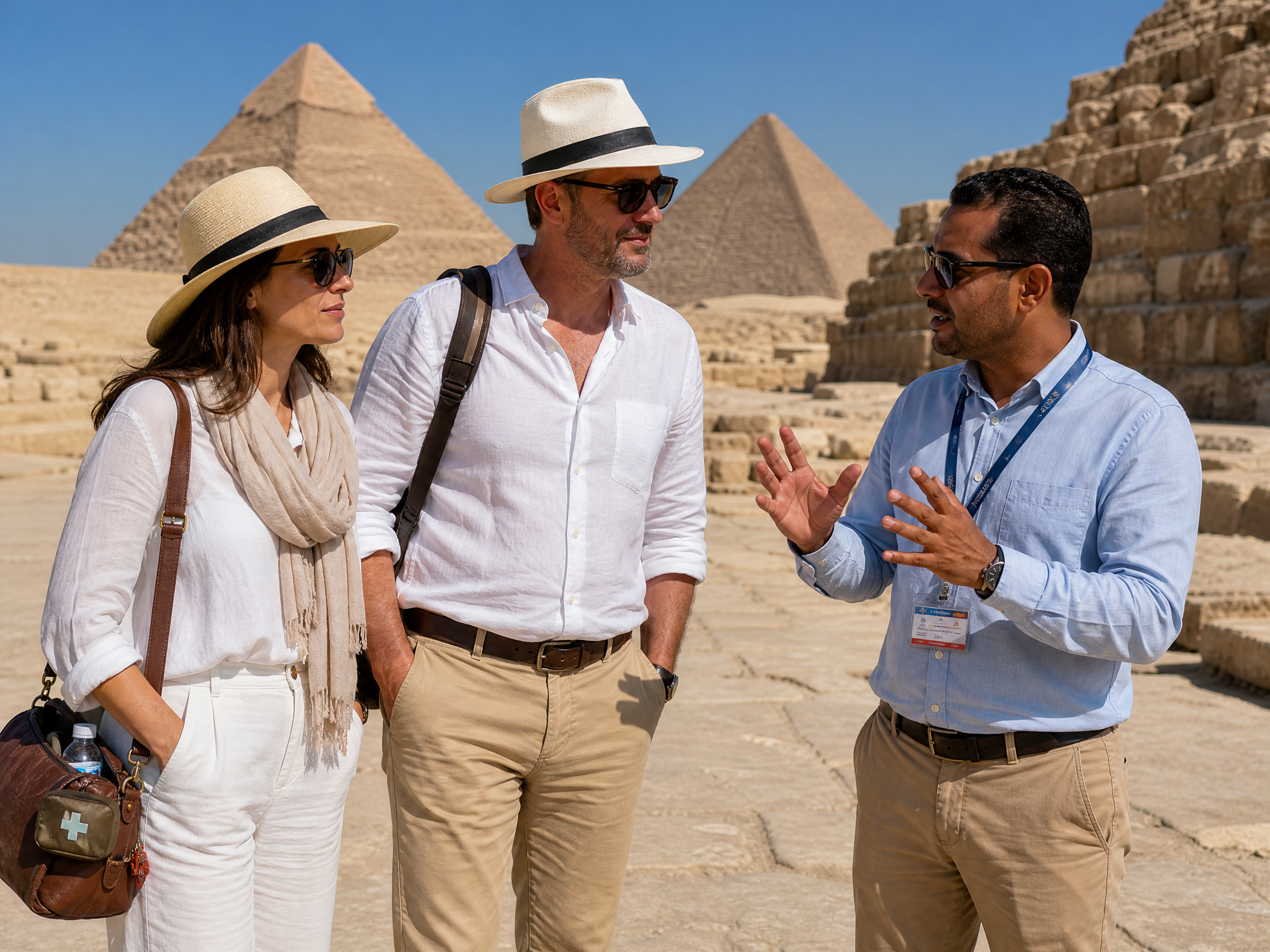
A private iLuxury Egypt journey addresses most of these indirectly. You travel in a private vehicle rather than a shared bus. You visit sites at the times of day when they are least crowded early morning at the Pyramids, before the tour groups arrive. Restaurants are selected and confirmed in advance, with your dietary requirements communicated. Your Egyptologist manages the logistics of each day so that you are focused on the experience rather than the planning.
None of this replaces appropriate health preparation. But it does mean that many of the health friction points exhaustion from disorganized travel, exposure to crowded conditions, uncertainty about food quality are significantly reduced compared to independent or group tour travel.
Tips from iLuxury Egypt's travel team
Tell your iLuxury Egypt team about any dietary restrictions, food allergies, or medical conditions that affect how your itinerary should be structured before you travel, not after you arrive. Every restaurant, hotel, and Nile cruise on your itinerary can be briefed in advance. Communicating on arrival is less reliable than communicating in the pre-trip consultation.
Plan your travel medicine appointment before you book non-refundable flights, not after. If your doctor identifies a health concern that requires a scheduling adjustment extra time to complete a vaccine series, for example you want to know this while your travel dates are still flexible. The appointment itself takes thirty minutes and is worth doing at the planning stage.
Jet lag affects the first two days of an Egypt trip more than most travelers anticipate. Cairo is seven hours ahead of Eastern Time. Arriving one day before your itinerary begins rather than arriving the morning your tour starts gives your body one night to adjust before the Pyramids at sunrise. Your iLuxury Egypt team can advise on how to structure arrival day based on your flight routing.
Egypt's archaeological sites involve more walking than most travelers expect. The Valley of the Kings involves significant uphill walking in open sun. Abu Simbel requires walking on uneven ground. The Grand Egyptian Museum involves hours on polished stone floors. Physical preparation before the trip regular walking in the weeks before departure makes a meaningful difference to how you feel in the second half of a ten-day itinerary.
Frequently asked questions
Do I need vaccines to travel to Egypt?
No vaccines are required for entry to Egypt from the United States. Several are commonly recommended by travel medicine physicians including Hepatitis A and ensuring routine vaccines are current. Consult your doctor or a travel medicine clinic four to eight weeks before departure for personalized recommendations based on your health history.
Is Yellow Fever vaccination required for Egypt?
Yellow fever vaccination is required only for travelers arriving from countries where yellow fever is endemic primarily certain countries in sub-Saharan Africa and South America. Travelers arriving directly from the United States do not need a yellow fever certificate for entry to Egypt. If your Egypt trip follows travel to any potentially affected country, check current requirements through the CDC before departure.
How far in advance should I prepare health-wise before Egypt travel?
Four to eight weeks before departure is the standard guidance. Some vaccine series require multiple doses spaced weeks apart. Starting eight weeks out gives full flexibility. If your trip is less than four weeks away, a travel medicine appointment is still worthwhile single-dose options and prescription medications can be arranged on a compressed timeline.
Is tap water safe to drink in Egypt?
No tap water in Egypt is not recommended for drinking by international travelers, regardless of where you are staying. All iLuxury Egypt properties and vehicles provide bottled water as standard. Use bottled water consistently throughout your journey, including for brushing teeth.
Should I bring prescription medications to Egypt?
Yes bring a full supply of any medication you take regularly, plus a five-day buffer. Keep medications in your carry-on luggage. While pharmacies exist in Cairo, Luxor, and Aswan, finding a specific medication formulation is not reliable. Inform your iLuxury Egypt team of any medications requiring refrigeration so arrangements can be confirmed at each property in advance.
Do luxury travelers need different health precautions?
The same general health preparation applies regardless of travel style. The practical difference is that a private luxury itinerary with private transportation, pre-selected restaurants, and early morning site visits before crowds arrive reduces many of the logistical situations that contribute to health issues on Egypt trips. Vaccine preparation, travel insurance with medical coverage, and a basic travel health kit remain important regardless.
Where can I find the most current vaccine recommendations for Egypt?
The CDC Travelers' Health page for Egypt (wwwnc.cdc.gov/travel/destinations/traveler/none/egypt) is updated regularly and is the most authoritative source for current recommendations. Your doctor or a travel medicine clinic can translate these recommendations into personalized advice based on your specific health history and itinerary.
Can children travel safely to Egypt?
Yes Egypt is a destination that families with children visit regularly, including on private itineraries. Children's vaccine requirements and health precautions should be discussed with a pediatrician before travel. Practical considerations for families itinerary pacing, heat exposure, food options are things your iLuxury Egypt team addresses during the pre-trip consultation for family journeys.
Planning a private Egypt journey and want to discuss health preparation specific to your itinerary including dietary requirements, medication storage, and pacing considerations?