
The Grand Egyptian Museum is the largest archaeological museum ever built for a single civilization twelve galleries, over 100,000 artifacts, and more than 5,000 years of history under one roof. A Grand Egyptian Museum private tour pairs a single traveling party with a senior Egyptologist for a dedicated visit through it, typically two and a half to four hours, built entirely around what that party wants to see and understand.
Walking through a museum this size without a guide is, in practice, like reading a library in a language you don't speak. You can see that the objects are extraordinary. You can't understand why what a particular choice of material meant, what a symbol was doing on a coffin lid, why one object was buried facing a specific direction. A private Egyptologist closes that gap in real time, standing beside you rather than somewhere ahead of a group of thirty people trying to hear the same explanation over each other's footsteps.
This guide covers what a private visit to the Grand Egyptian Museum actually involves, what makes the Tutankhamun collection different from anything previously on public display, the practical details American travelers consistently ask about, and how the museum fits into a broader Cairo itinerary.
What Makes This a Private, VIP-Level Visit
A standard museum visit gives you proximity to extraordinary objects. A Grand Egyptian Museum private tour gives you access to the stories inside them and the difference is entirely in who is standing next to you when you look.
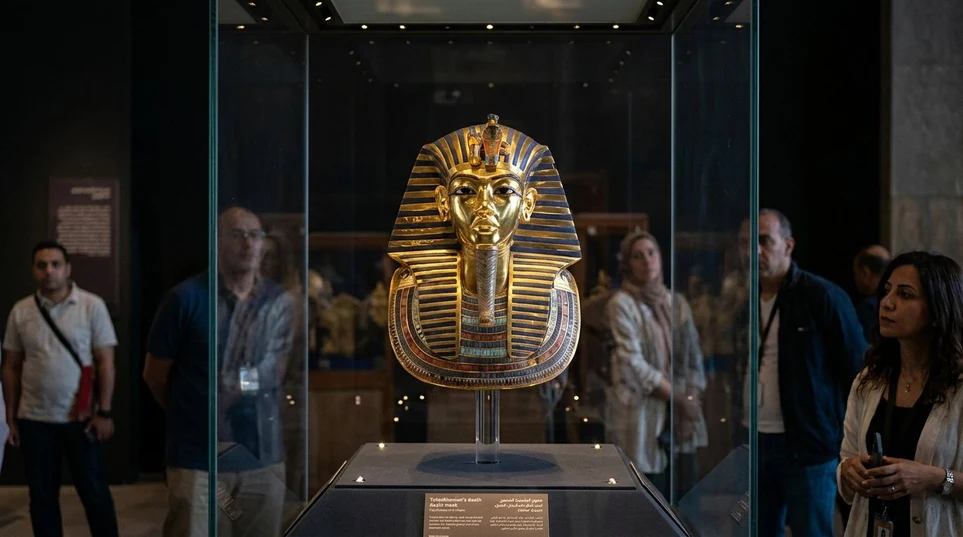
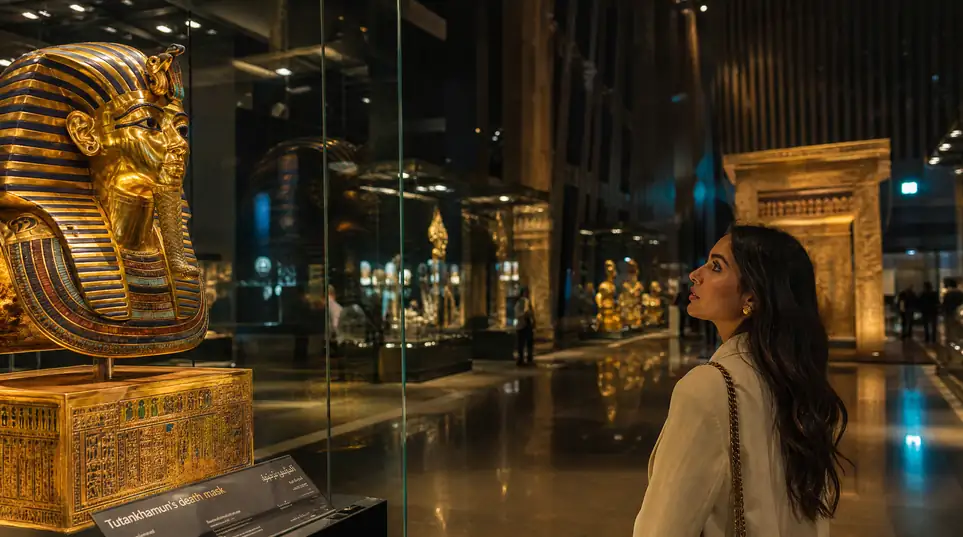
Your Egyptologist doesn't recite the wall labels. They read the objects themselves the iconography, the inscriptions, the choices made by craftsmen working three thousand years ago and explain what those choices actually mean. Standing in front of the golden mask of Tutankhamun with a private Egyptologist isn't simply looking at a famous object; it's being told why it was made the way it was, what it was meant to accomplish in the afterlife, and what it reveals about a boy king who died at nineteen and was buried with more artistry than almost any ruler in history.
There's a specific kind of moment this produces that's difficult to get any other way. A general visitor sees a painted chest and moves on. An Egyptologist can point to the scene painted on its side a hunting expedition, a battle, a ceremonial procession and explain who is depicted, what the artist was recording, and why that particular scene was chosen to accompany a king into the afterlife. The object doesn't change. What you understand about it changes completely.
That level of understanding isn't available from a label or an audio guide, both of which are necessarily written for the widest possible audience and therefore say the least specific thing that's still accurate. It comes only from someone who has spent years earning the knowledge, and who for this one morning is entirely yours to ask, redirect, and slow down for.
The Tutankhamun Collection: What's Actually New Here
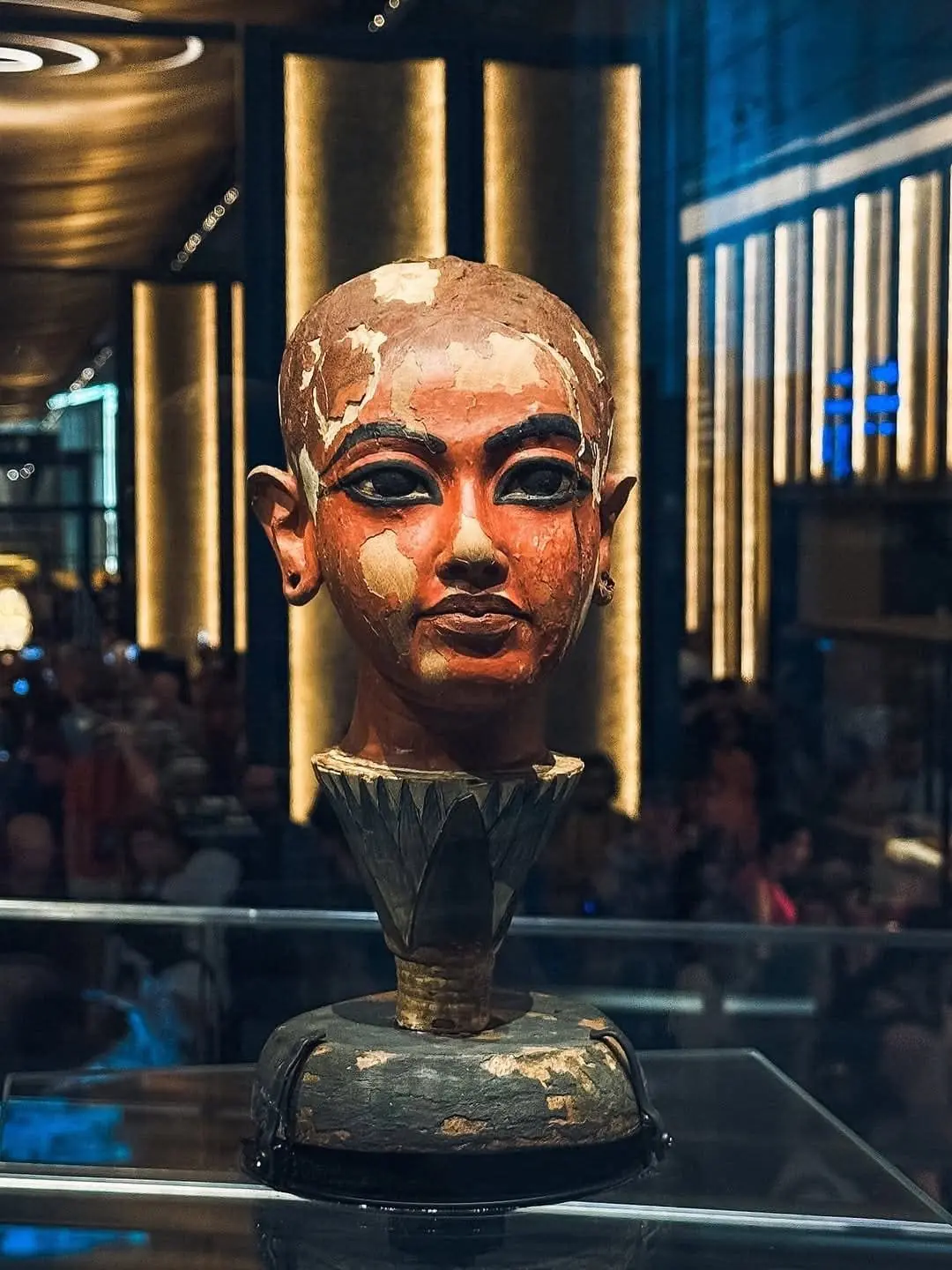
For the first time in history, the complete treasures from the tomb of Tutankhamun are displayed together in a single dedicated gallery. Over 5,000 artifacts including approximately 2,000 that have never been exhibited publicly before are now visible in their entirety at the Grand Egyptian Museum. Since the tomb's discovery in 1922, its contents have been split across storage, partial exhibitions, and international loan shows; this is the first time the full collection has been reassembled in one place.
The golden mask remains the most recognizable object in ancient Egyptian history, but it sits among pieces that are equally extraordinary and far less understood: chariots built for a king too young to have driven them, thrones inlaid with materials sourced from across the ancient world ivory, ebony, precious stones traded along routes stretching well beyond Egypt's borders and ritual beds shaped like animals that appear in no other known tomb. There are also the mundane objects that rarely make it into popular coverage: linen garments, folding stools, board games meant for an afterlife that was expected to resemble ordinary life closely enough to need furniture.
A private Egyptologist moves through this collection as a scholar rather than a narrator able to explain what each object was made to do, and why it was positioned exactly where it was in the darkness of the tomb for three thousand years. The placement of objects in Tutankhamun's tomb wasn't random storage; it followed religious logic about what the king would need, in what order, and in what part of the afterlife journey. Understanding that logic is what turns a room full of gold into a coherent belief system made physical.
For many iLuxury Egypt guests, the Tutankhamun gallery alone justifies the trip to Egypt. With a private Egyptologist beside you, it becomes something very few people in the world have actually experienced not simply seen.
The Numbers Behind the Museum
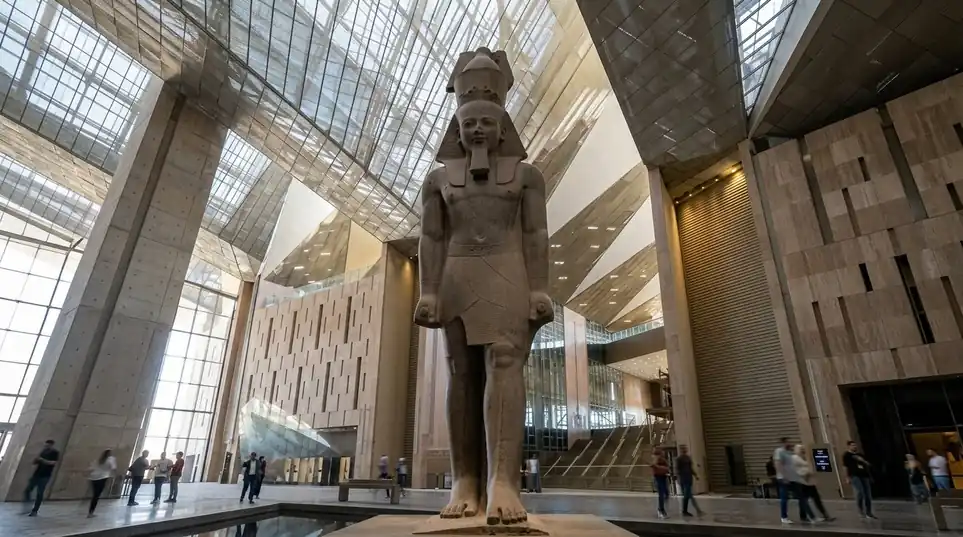
Worth citing directly: the Grand Egyptian Museum opened officially in November 2025, after more than two decades of construction. Its twelve main galleries span 45,000 square meters and are organized chronologically from the earliest pre-dynastic artifacts, through the New Kingdom at the height of Egypt's imperial power, to the Late and Greco-Roman periods. A colossal statue of Ramesses II greets visitors in the Grand Atrium, and the reconstructed solar boat of Khufu one of the oldest intact wooden vessels ever discovered occupies an entire dedicated hall of its own.
To put the scale in perspective: the museum's total footprint is large enough that a standard, unguided visit takes most travelers between three and five hours and still covers only a fraction of what's actually on display. Visitors moving through without guidance tend to gravitate toward the same handful of famous objects the mask, the throne, a handful of statues and walk past entire galleries of material that would reward equal attention if they knew what they were looking at.
A private tour is built differently: your Egyptologist identifies what's genuinely unmissable for your specific interests, explains the museum's underlying chronological and thematic logic, and gives you the context to actually understand what you're looking at rather than simply photographing it. The result is a visit that goes deeper in less time and stays with you longer than any photograph would.
How the Visit Is Arranged, Start to Finish
Your driver waits at your hotel entrance the door, not the lobby at a time confirmed the evening before. A private vehicle takes you directly to the museum, and your Egyptologist meets you on arrival. Tickets, access, and every logistical detail are confirmed before you land in Egypt, so there's nothing to queue for and nothing to manage on the day itself.
Your Egyptologist is selected in advance based on your specific interests. If the Tutankhamun collection is the primary focus, the visit is structured around it, with extended time in that gallery and a lighter pass through earlier periods. If you'd rather take a broader chronological journey through the full sweep of Egyptian history from the earliest pre-dynastic material through the Greco-Roman period your Egyptologist builds the morning accordingly, pacing each era to leave enough time for the sections that will matter most to you. The museum and the itinerary within it is shaped entirely around what you actually want to experience, not around a fixed route designed to move the maximum number of visitors through in a set time.
This matters more at the Grand Egyptian Museum than at almost any other site in Egypt, precisely because of its scale. A fixed-route group tour has to choose a single path through twelve galleries and stick to it regardless of what's holding a given visitor's attention. A private visit can abandon that structure entirely spending forty minutes in the Old Kingdom gallery because a specific statue has sparked a genuine conversation, then moving quickly through a section that's less relevant to what you came to see.
Combining the Museum With the Pyramids
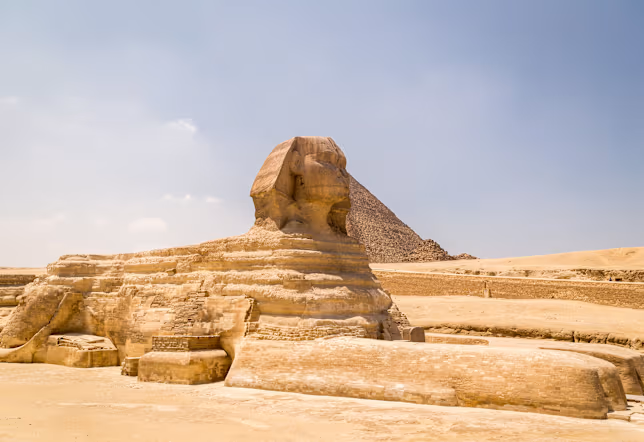
The Grand Egyptian Museum sits less than two kilometers from the Giza Plateau. For many guests, the most powerful combination in Cairo is a private Pyramids sunrise tour followed immediately by a Grand Egyptian Museum private tour on the same morning the monuments at dawn, then the artifacts that came from inside monuments just like them, guided by the same Egyptologist throughout.
Standing in front of the Great Pyramid at sunrise and then, two hours later, standing in front of the golden mask buried inside a tomb just like it the furniture, the jewelry, the objects made for eternity creates a continuity of understanding that no other city in the world can offer. Seeing the exterior of a monument built to house a king and then, hours later, seeing exactly what that kind of monument actually contained closes a loop that neither experience completes on its own. iLuxury Egypt arranges both as a single seamless morning, with the same Egyptologist carrying the same thread of explanation from the plateau into the galleries.
What American Travelers Should Know Before Visiting
A US e-Visa can be obtained online before travel, or arranged as a visa on arrival at Cairo Airport full guidance is covered during the pre-trip consultation, and most guests find the e-Visa process straightforward when started at least a few weeks ahead of departure. All iLuxury Egypt services are quoted and payable in US dollars, and major credit cards are accepted throughout; your Egyptologist and driver handle all local arrangements, so there's no need to carry Egyptian currency for anything related to the tour.
The museum sits in Giza, roughly 30 to 45 minutes from central Cairo hotels depending on traffic your private vehicle manages the transfer entirely, with no navigation required on your part and no need to coordinate transportation separately from the rest of your itinerary. The building is fully air-conditioned with no religious dress requirements, so comfortable attire is appropriate throughout; unlike some religious sites elsewhere in Egypt, there's no need to plan around modest-dress requirements for a museum visit.
The museum is open year-round, and morning arrivals timed at or shortly after opening offer the quietest experience, with fewer visitors in the main galleries and shorter waits at any checkpoint. iLuxury Egypt schedules your visit specifically to avoid peak visitor hours, which at a museum of this size tend to build steadily from mid-morning through early afternoon rather than clustering sharply the way they do at outdoor sites like Giza.
Flights from major US cities typically run 11 to 14 hours to Cairo with one connection, most commonly through a European or Gulf hub, landing at Cairo International Airport. Your iLuxury Egypt team can advise on routing and preferred carriers on request, and can coordinate arrival timing so your first full day isn't scheduled immediately after a long-haul flight.
Why a Private Visit Changes What You Actually Take Away
It's worth stating plainly what the difference between a private and a general-admission visit actually produces, beyond comfort. A general-admission visitor at the Grand Egyptian Museum typically leaves with a set of photographs and a vague sense of having seen something impressive. A guided private visitor typically leaves able to explain, months later, why a specific object mattered what problem it solved, what belief it represented, how it connects to the broader arc of Egyptian history they walked through that morning.
This isn't a matter of the museum being poorly labeled. Museum labeling, even at its best, has to communicate to a visitor with no prior context in roughly two sentences. A private Egyptologist isn't bound by that constraint they can answer a follow-up question, correct a misconception on the spot, or connect an object in one gallery to something you saw an hour earlier in another. That kind of layered, responsive explanation is structurally impossible to deliver through a label, an app, or a pre-recorded audio track, regardless of how well any of those are written.
Frequently Asked Questions
Do I need to book museum tickets in advance?
No — iLuxury Egypt handles all ticket arrangements before your visit. There's nothing to purchase, queue for, or manage on the day; everything is confirmed as part of the pre-trip consultation.
How long does a Grand Egyptian Museum private tour take?
Typically between two and a half and four hours, depending on interests and pace. Your Egyptologist moves at whatever pace feels right there's no fixed schedule and no obligation to cover every gallery.
Can the visit focus entirely on the Tutankhamun collection?
Yes. If the Tutankhamun gallery is the primary interest, the entire visit can be structured around it, with your Egyptologist providing the context that makes the collection genuinely comprehensible rather than simply impressive.
Is Egypt safe for American travelers?
Cairo and the major archaeological sites are well-established destinations welcoming millions of international visitors each year. iLuxury Egypt monitors conditions continuously and remains available around the clock throughout your time in Egypt, with full pre-trip guidance provided for first-time American travelers.
Can this be combined with a Giza Pyramids visit?
Yes — this is one of the most frequently arranged combinations. A private Pyramids sunrise tour followed by a Grand Egyptian Museum private tour on the same morning is one of the most complete single-day experiences available anywhere in Egypt, arranged with the same Egyptologist throughout.
How far in advance should this be planned?
At least three to four weeks before travel dates is recommended. Senior Egyptologists are in high demand, and advance planning ensures the right match for your specific interests and schedule.
Is the museum suitable for travelers with limited mobility?
Yes — the Grand Egyptian Museum is a modern, fully accessible facility with elevators and level access throughout the main galleries, unlike many of Egypt's older archaeological sites where terrain can be a genuine constraint. This makes it one of the more comfortable major sites in Egypt for travelers who want a full, unhurried visit without significant walking or stair demands.
What's the difference between visiting alone and with a private Egyptologist?
A general-admission visit gives you access to the objects; a private Egyptologist gives you access to why those objects exist, what they meant to the people who made and used them, and how they connect to the broader history the museum is organized around. The objects don't change what you understand about them does.
One hundred thousand artifacts. One Egyptologist chosen for you. One morning that changes how you see the ancient world.